
My selfie stick broke.
I don’t usually have one. In fact, I abhor them. But practicality-wise I thought it a good investment considering how much lone travel I’d be doing. It broke before the end of my first week. What to do?


I’m having weird dreams when my alarm wakes me and I sit up with head throbbing. The antibiotics are working and I can hear my chest clearing, but I don’t feel good. Continental breakfast is juice with bread and jam. It’s all I can tolerate. As I sit picking at my food, another guest uses a bathroom nearby, and I can hear her vomiting. She stumbles away and I realise she is still drunk. Then I remember it was Saturday night last night.
The taxi arrives on time to take me to the train station. As I sit waiting along with a large number of other extranjeros or foreigners, I read a sign telling me Peru Rail will not allow more than 8kg in a carry-on size bag. I watch others rearrange their luggage and I have a quiet freak out. Foolishly, I didn’t read the terms and conditions in minute print. My concerns turn out to be pointless, because when we are called to board one of the train staff picks up my bag without a word and stores it away for me. The term laissez-faire comes to mind.


The train wanders four hours through the Peruvian countryside with spectacular views of snow-capped mountain tops, deep ravines, and fast-flowing glacial rivers. It is a unique way to arrive at Aguas Calientes, a township at the base of Macchu Picchu. The train’s ceiling is made of glass panels to give fantastic opportunities for photos, oohs, and ahs. Unfortunately, it also has a conservatory effect; I paste sunscreen all over my face and arms and try to avoid direct sunlight for too long.
I chat with a young, well-travelled American couple who give me great advice for the area and later travel.
A classy snack is served, and many sit back to enjoy the comfort, while outside we pass fields of corn and potatoes amid which sit modest villages of mud-brick dwellings. The soaring cliffs and crags are a taste of what is to come. We pass the drop off point for trekkers braving the four- or one-day Inca Trail treks, camping out in the weather.


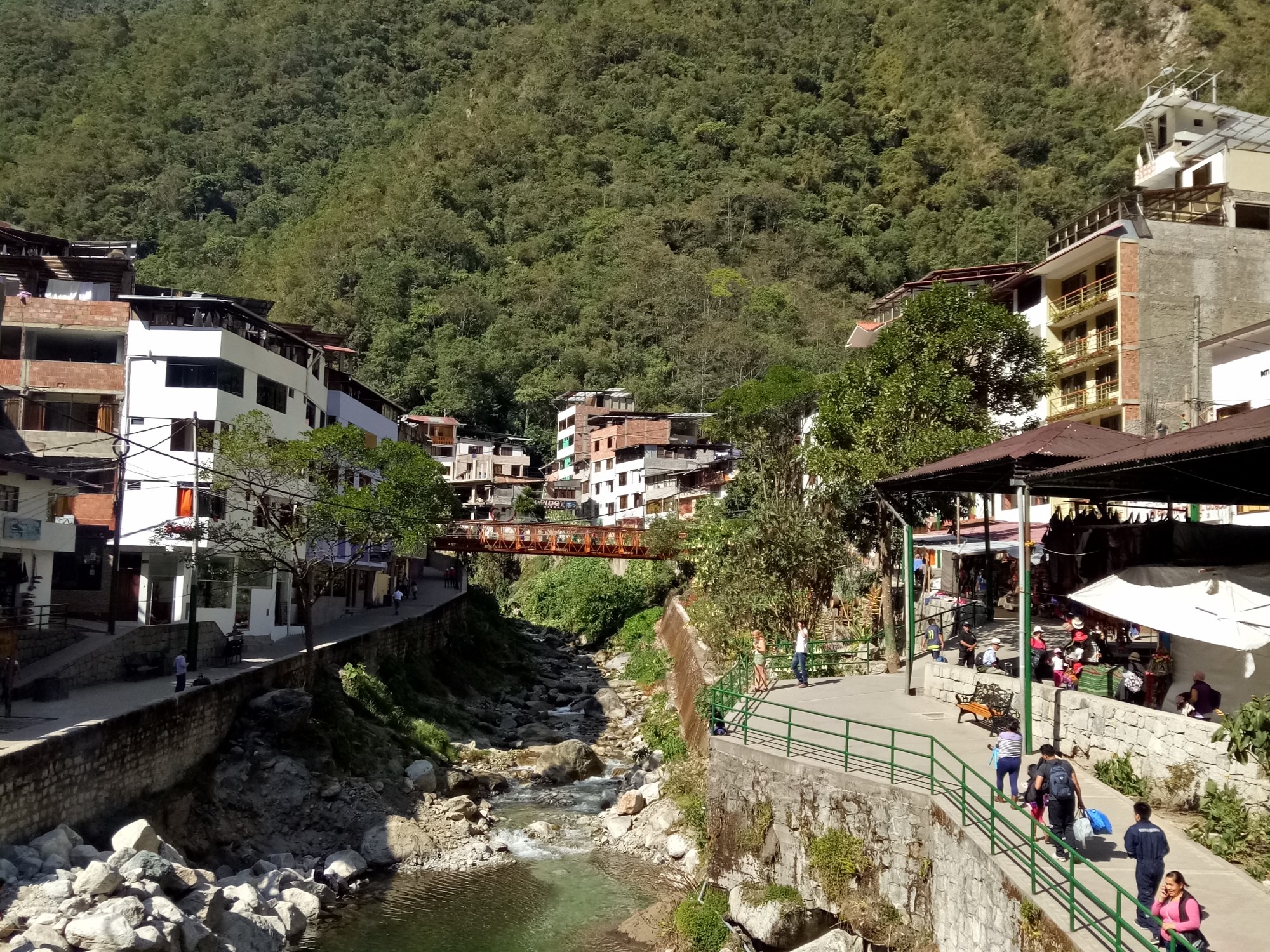
The train slows to enter the town on Aguas Calientes, which appears to have been wedged between the sheer sided cliff faces covered with green foliage and the steep flowing river. As you disembark, you enter a vast maze of ramshackle tent-like tourist markets with vendors selling their wares from trestle tables filled to overflowing with bright coloured ‘Cusco’ or ‘Macchu Picchu’ bags, rugs, dolls, magnets, etc.


I drag my bag up the steep market paths to emerge into the sunlight facing the river, over which rest 3 or 4 pedestrian bridges. The other side of the river’s street is lined with hostels, shops, and restaurants. It is touristy but not gaudy.The sun reflects off the river, and combined with the surrounding strength of the foothills, makes for an awesome sight. It is beautiful.
I am drawn to a tiny sign – Varayoc Hostel. Once again I am surprised they have space. My room faces the river, and its rushing sound is the backdrop to all that happens here. I walk through the paved streets and alleyways in awe. Quechua women, with their long black plaited hair, trilby hats, gathered skirts, and colourful jackets, sit with children or carry heavy loads. I am later told that if a woman has plaits tied together, this denotes that she is married; untied means single. Another Plaza, another fountain, and another statue to Pachacuti – smaller versions – are highlights, as are the Aguas Calientes or warm baths after which the town is named. I brought my swimming togs on purpose.


The climb is good exercise and you get glimpses of them as you ascend.It is popular with locals and tourists, and I find that many are visiting from other South American countries. I choose the nearest warm bath, a deep square swimming pool with opaque sulphur-smelling water and small rocks that look like pumice stones at your feet under the water.
It’s an odd and slightly uncomfortable feeling to sit a big bath, wearing not much at all, with about ten strangers. I am used to being stared at by now, but this time I am not the only white person. However, as I enter I see a Peruvian man looking quizzically at the tattoo on my upper thigh. The water is warm but not hot, and quite soothing. The Incas used the hot springs, now made into baths, as a retreat. I last about 30 minutes before emerging and walking quickly to get dressed before I get cold. Outside the change-room I pause to get a selfie; the downside to travelling alone. A nearby female police officer , keeping an eye on the crowd, offers to take it for me. When someone wanders into her shot of me, she gets cranky at them and uses her authoritative voice. They scuttle out of the way. Later, when I get back ‘home’, people are in the street noisily enjoying themselves while I sit and munch on a snack knowing that I have to get up in less than 8 hours at 4 a.m., to catch the bus up the hill – the hill called Macchu Picchu.
 Jen's Magic Carpet Ride