

I wake suddenly at 330 a.m. and can hear voices outside. I look out the window and in the street I can see people in the well-before-dawn gloom. The race is on. Get to the queue before it gets too long or you miss the opportunity to be one of the first to arrive at MP.
I shower, zip up my bag, mount four more lots of steep steps inside the hostel to reach the breakfast area where a señora is preparing fresh pineapple, and eat quickly – the line outside is growing by the second. I leave my bag in storage and walk outdoors into the cold. The line-up for the buses is already 100 metres long at 410 a.m. As I wait, more people emerge to join the queue. But the first buses will not start leaving until 6 a.m., continuing at 5 minute intervals. We wait, stamping our feet like horses in the cold, with murmurs and quiet laughter.


I look up and can see a few stars – a good omen for a clear day. I overhear French, Spanish, Chinese, Portuguese, Japanese, English. All newcomers express surprise and frustration when they see the length of the queue, which can be understood in any language.
An American man nearby gives me the lowdown on arrival, bus action, and the best way to enter once we disembark. They went up yesterday but are climbing a different part today. I silently worry about whether my ‘adjusted’ sold out ticket will still pass inspection or if I will get turned away right at the point of entry.
It reaches 6 a.m. At once there is a push toward the buses as they start to load. Excitement ripples through the crowd. At last our wait is over and we are herded into our bus. I manage to score a front seat. Did I mention that I am afraid of heights? This choice of seat is probably not a good idea after all as, once we get to the mountain, the switchbacks are hair-raising with drop-offs that any Andean condor would enjoy.
After 20 minutes of the bus driver skilfully maneuvering around obstacles and pot holes we reach a flattened area with restaurant and toilets (baños – a very important word). There are already fifty or so people milling around the unassuming entrance, lining up in rows to pass through the turnstiles where serious-faced Peruvian officials sit, stamps at the ready. I was in the fourth or fifth bus so it is not too busy yet at 630 a.m.There is not even a glimpse of the thing we are here to see. It is hidden behind hills and foliage. Buoyed along by excitement and energy, it is reasonably quick work to have my ticket stamped (whew!) and passport viewed.
I rush up the path and round the corner.
There is Macchu Picchu in all its splendour. I pause to take it in.
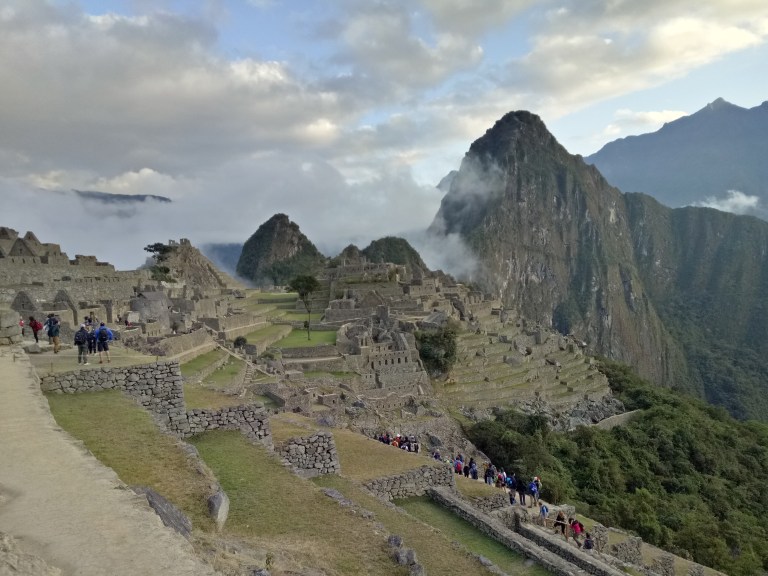
The setting is spectacular. It is carved into the mountain top surrounded my more imposing peaks. The enormity of place dawns on me. Macchu Picchu is not just a few buildings like I thought but an entire city. Its vastness is surmounted only by its detail.
I came to Peru to see this and I can’t quite believe I am here looking at it. I don’t recall taking any ayahuasco hallucinogenic drink.
I breathe it in for a moment, then start the climb to higher ground for a better view. Rocks hewn into steps, irregular and flattened and uneven, are a chore but I want to get higher before the sun breaks over the tallest eastern peak.
There are a few llamas scattered around the site which adds a touch of whimsy to the solid history here. There are terraces to my left, some roped off for reconstruction work or to give the grass a rest from tourists. National park guards are wherever there are people, always ready with a whistle blow for those that infringe upon the infrastructure.
I climb at least 30 metres almost straight up, catching my breath before following a winding path of steps cut into the hillside which brings me to a higher terrace. From here I walk to a corner of the terraced edge where a wooden railing will lead me higher. I wait for two women to take their selfies here then prepare to ascend again. As I reach for the railing, I happen to glance past it. I stop and vertigo makes me swoon as I am looking directly down to a river valley at least a kilometre below. Unlike me, the Quechua appeared to not suffer from fear of heights. I am determined to face this fear, however, and have come on this trip to overcome it. But suddenly the wood seems rickety and the ground feels like it is sloping away from me ready to carry me off the edge. I decide this is far enough and do an about-turn. Yes the view from here is perfectly fine. I sidestep back to ‘solid’ ground.


The sun emerges from behind a distant peak and throws everything into stark relief, bathing it all in a warming glow. Every direction displays a magnificent vista. I walk around, always noting how I will get back down to level ground. I am not walking with a guide but I can overhear their commentary in different languages as I pause.
I wanted to feel this place without knowing all there was to know before coming. (I believe that the marvelous interweb and Google maps or street view can sometimes remove the mystery of discovering a place for the first time.) At the same time, there is a time pressure as I want to see as much as I can before the bulk of the crowds arrive. I reach another high point via more stable access and stop. As I turn around the full magnitude and sanctity of the place hits me.
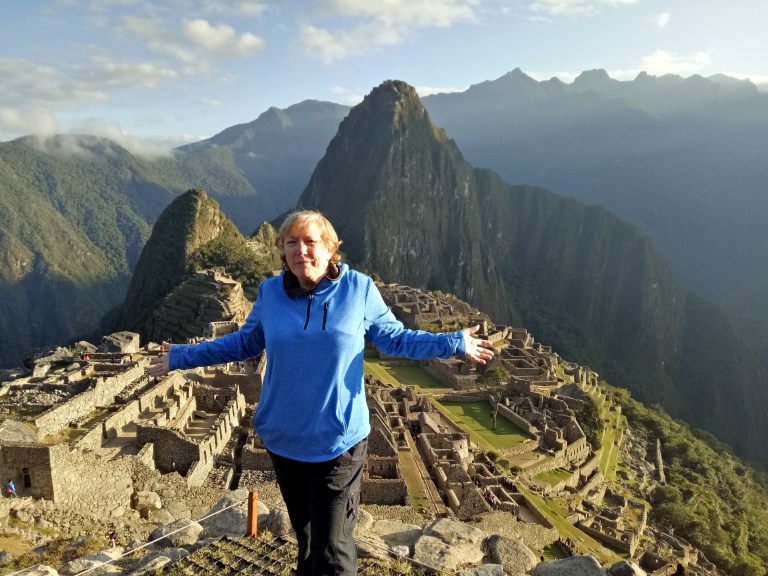
It is breathtaking. The photos only give a glimpse of all that Macchu Picchu reveals close up. Rocky buildings are perched on cliff faces and are made with stone blocks cut with perfect and almost scientific precision, with each window or doorway opening onto another amazing scene. This full city has sacred spaces, an agricultural sector, Royal edifices, jails, fields and open spaces for gatherings, sacrificial altars, outbuildings for watchmen, housing for the chosen sacred women among others; many still intact though without their thatch roofing.


I make my way down to the central plaza area where a family of llamas graze. Their grass is roped off but I walk along the flattened dirt beside them, a path that takes those with more bravery than I have to Huayna Picchu – the enormous big brother, if you like, that overlooks younger brother Macchu, seeming to guard him with a stern unfaltering gaze. Trekkers can climb the steeper paths of Huayna. I watch them go with no fear of missing out.


I find a quiet spot to sit and rest. Soon after I am politely asked to move on by one of the guards. I explain that there was no rope to tell me I was out-of-bounds. He smiles and asks me again to move on. I apologise and his smile broadens.
I make my way back through the main square to a less travelled path and find myself in a maze. I enjoy getting lost and carefully stepping into history through doorways into the past. I imagine how the Quechua lived here, what they wore, their daily routine; with each moment of their existence captured by beams of sunlight highlighting a man here, a woman there, or a child playing hide-and-seek in one of the crannies. A zigzag path leads me to what would seem a dead-end but I pursue it and find to my delight a hidden exit through which is yet another level.


My reverie is broken and I am brought back to the present by voices in different languages. I follow the sound and find I am near the site exit. I decide to go down to the bathrooms outside the entrance, waiting in line to pay 1 sol (about 20 cents). The toilets are modern, clean, and flushing, which surprises me. I expected outdoor toilets, especially this high up. But the Peruvians have proved to me that they are organised when it comes to tourism despite my original laissez-faire perception. Unfortunately, after using the bathroom, I have to line up again with the now swarming tourists to re-enter the site. You’re allowed out and back in twice. With passport and ticket ready, I make my way back in and enjoy sitting under a shaded wooden alcove watching people and hearing their cries of delight and wonderment upon first view of Macchu Picchu laid out before them.
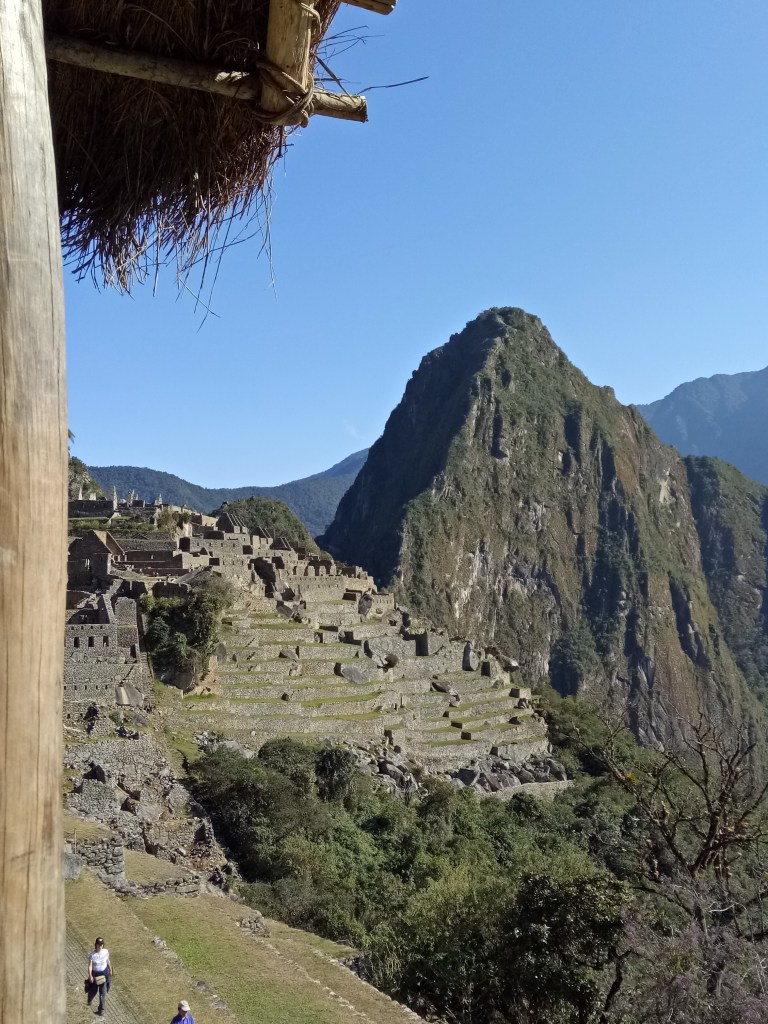
Finally, I have gulped in enough fresh air and history. It is getting hot and tourist numbers are peaking. I struggle through the crowds at the entrance to the buses and tolerate the same scary ride back down the mountain to Aguas Calientes, feeling replete. There, I chill out in a cafe and think about whether or not I really had been up the hill.
 Jen's Magic Carpet Ride