

Every footstep I make crackles, even though I pace lightly. Salt smell fills my nostrils. Our group speaks in muffled, awed, tones.
I am walking on what looks like the moon; it feels not of this world. It looks like a frozen wasteland. I am in the Salt Flats (Salar) of Bolivia.
Another pre-dawn departure, and we have driven onto an enormous 12,000 square kilometre plain made of salt that is 20 metres deep. We are all stunned into silence as we drive across it toward the lightening sky and a small hill in the far distance.
Twenty minutes later, the hill evolves into an island, Incahuasi Island, used by the Incans as a base for respite. It rises from the salt like an apparition. Our driver drops us off here and disappears, telling us to walk around the island’s edge after dawn. We are left alone and in silence in the cold morning air, with sunrise breaking gently over us.


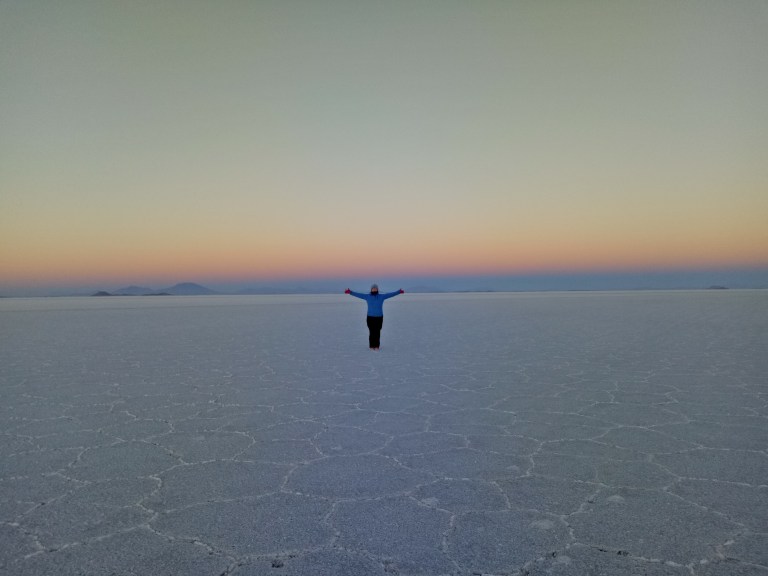


We linger in silent worship to the dawn for half an hour breathing in the moments, then, as one, turn and head toward the cactus-laden island. As we round the corner we see a few 4 wheel drives have pulled up in a row alongside flags from different countries. Our driver has brought breakfast along and soon we will be sitting at the salt tables, covered in their bright woven cloths, eating fruit and pancake-bread and drinking coffee in the cold, marvelling at the vista before us.
But first, a little exploring. I climb the rocky path to the left. I can see a Bolivian flag, flapping in the slight breeze, high up on a crest. That is my aim, to get there before tourists from the other vehicles spoil my respectful solitude.


But once I reach the top, the view takes my breath away and I dawdle. This island is in the middle of a vast nothingness.


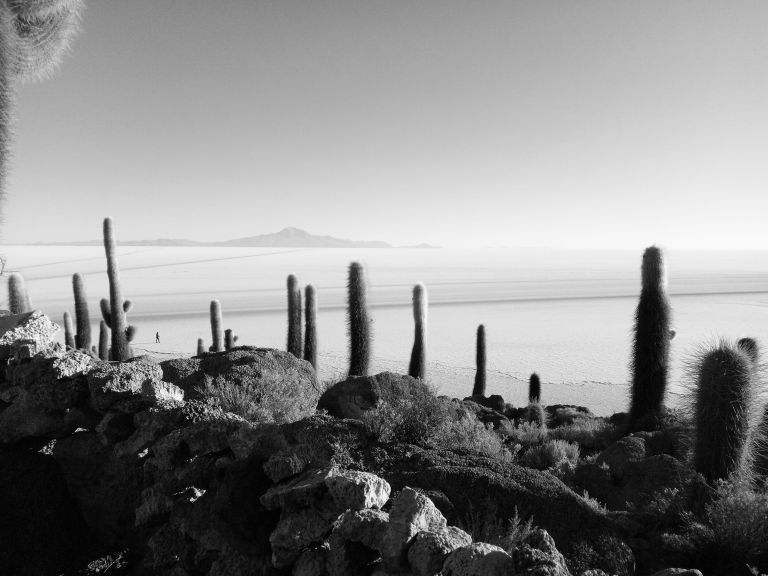
Other tourists start the climb up so I descend to breakfast.

I am feeling better today and can tolerate food. Others in our group are not so fortunate. We have rearranged seating to accommodate differing sickness levels with the healthiest, the two Brazilian ladies, in the back seat. I am happy to get a window.
After breakfast, we drive into the midst of the salt pan to take fun pictures. When it rains – usually in November or December – the salt flats fill up like a shallow bath and because it is so flat the reflections of the sky make it look as if there is an endless panorama with no horizon. Even though it is dry for my visit, it still astounds me.


After another hour in the sun, I am replete from my dose of the salt of the Salar de Uyuni. I am reluctant to leave this otherworld that I have come so far to see but the heat is worsening (possibly due to the highly reflective surface we are on), so we re-enter the car with relief and drive on to our next stop, another salt hotel festooned with flags of different nations.


Our trek/tour is drawing to a close; at the town of Uyuni after lunch we change drivers, lose three from our group and add another couple for the last overnight section back to San Pedro de Atacama in Chile, my starting point. We leave the Salar behind us and head toward Uyuni, first stopping at some points of interest: markets and a train graveyard for old trains that used to carry salt and mined minerals from Uyuni to the bigger cities.


In Uyuni, it is sad to see some of our group go; we have been through a lot together and our combined high spirits and sense of humour have made it a more fun experience. Finally, with promises to keep in touch, we go our separate ways, thank our driver, and walk into the office to wait.


Our new driver has better English and talks us – now only 5 – through any passing scenery. It is a more direct route on sealed roads to our last hostel before hitting the border next morning. We introduce ourselves to the new people, a couple from Uruguay. They have difficulty with my name. I spell it for them but because Spanish speakers pronounce J as a hard guttural H they don’t know why I am called Jen (dzhen) and not Hen (ghen). I laugh to myself. I may have to accept being called Hen by them for the rest of this trip.
However, I am now starting to feel quite unwell. I am surprised to find out that I have dozed most of the next two hour section our drive, waking suddenly when I hear the word ‘baños’ (toilets). I feel a bit squeamish but I am unsure which end will work first – vomiting or diarrhoea. I drag myself to the bathroom and pee, then return to the car. I ask anyone from our group for a plastic bag just in case I have to throw up. I am given a small one and am about to get back in the car when I feel it coming. I projectile vomit so quickly I don’t even have time to use the bag. I vomit where I stand, in the doorway of the car, into the street. I am too sick to feel embarrassed.
The driver is anxious to continue so I sit back in the car, feeling as if my whole insides have just come out of me, with head spins and swoons. I cannot think. The new lady pushes a pill into my hand and tells me to sip a tiny bit of water with it. It tastes bitter but I keep it down then fall into another deep sleep.
I am woken a few hours later by our arrival in the dark to our hostel. It has private bathrooms! I am sharing with the two Brazilian ladies who coo and tell me to shower and rest. I appreciate that I am being looked after. There is no way I can tolerate food so I use up all the hot water, put on as much clothing as I can and slip into the bed, feeling like death.
It is dark when I am woken but I know I need to leave and return as fast as possible to my hostel in San Pedro. We reach the lonely Bolivian border outpost in record time it seems and I am relieved to see the highway sign say República de Chile. Not long after I am returned to my hostel. I thank everyone, blow kisses to the Brazilian ladies, dump my bags in the hostel room, have a shower and fall into the most comfortable bed in the world.
I sleep for 16 hours.
 Jen's Magic Carpet Ride