
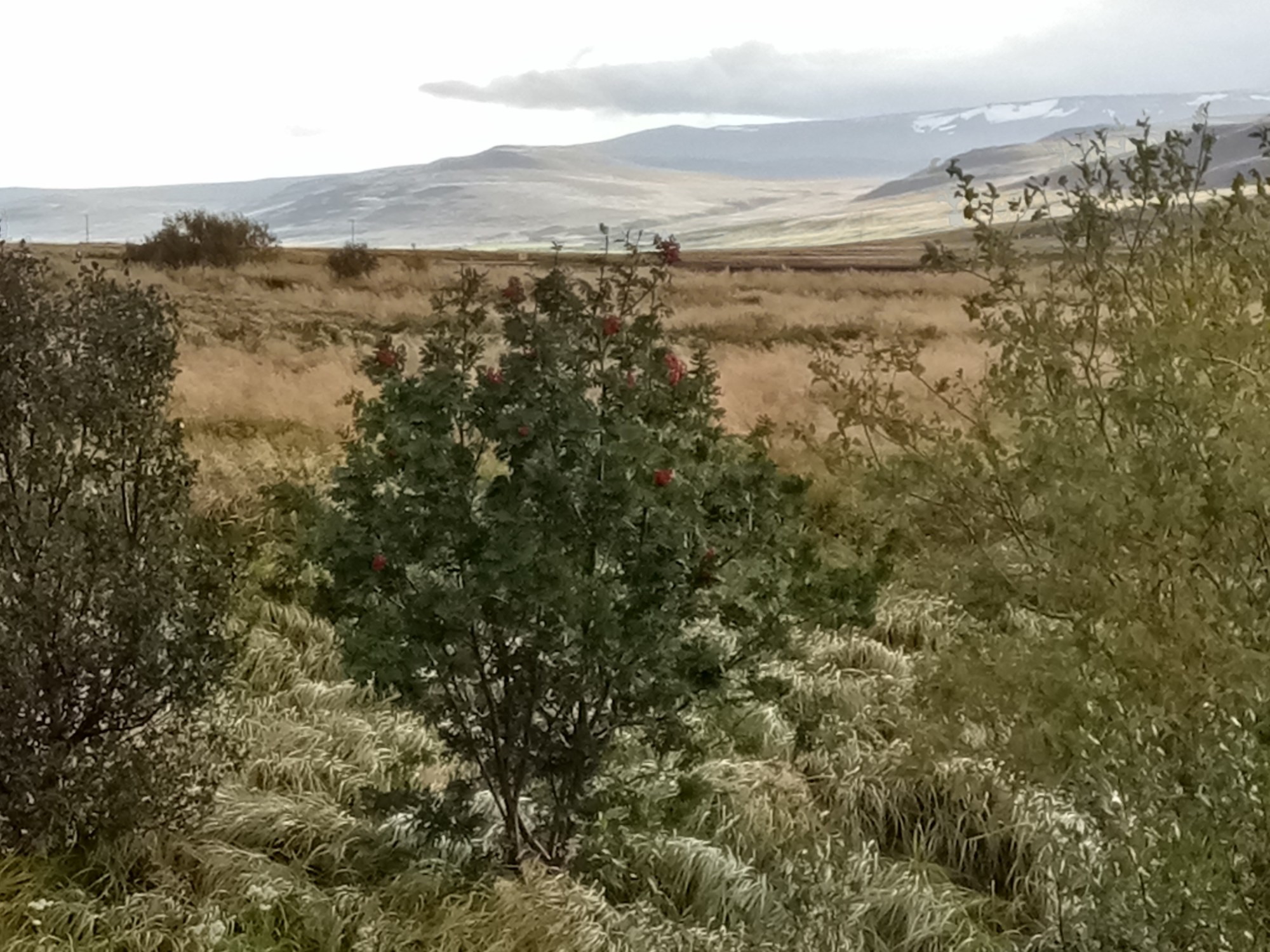
We descend gently through a blanket of cloud.
No, it would be nice if it were the case, but that is not this story. This time the cloud blanket is moth-eaten, and we bounce from hole to hole as if on a roller-coaster. From my window (yes, a window seat), I can see the North Atlantic Ocean far below and the white caps of the waves whose spray is blown away before they have time to break. During the bumpy landing, I look out onto what appears to be a bleak, desolate, and wind-swept place.
We are told we are arriving to a balmy 11 degrees Celcius. Icelandic humour. I will hear a lot of examples of this during my stay.
We exit the plane into rain, descending via covered stairs to the tarmac for a waiting bus. Out of the protection of the staircase, the passengers and staff are almost whipped off their feet by the gale force wind. Now I understand and appreciate what a great job the crew did of our landing. Even the seagulls wheeling overhead have trouble staying level, and the raindrops on the bus windscreen are horizontal.


Apart from my first two nights stay in a hostel, I purposely did not book or research or arrange anything prior because, as I have said previously, I like to find out, find my way, although of course what I have seen and heard of Iceland before arriving has drawn me here. But on the aircraft they had an interesting and informative in-flight magazine and introductory video you could watch. I read the magazine and decided there and then at least three things I wanted to do while in Iceland. I also realised that a week was not really a long enough time to do justice to seeing and doing all that I could, such as the Ring Road or the interior, so instead I decide to see as much as I can via day trips from the city of Reykjavik, as they are plentiful. This journey will just be a taste of Iceland.
One thing I had always wanted to see, and hoped to see in Iceland, was the Northern lights or Aurora Borealis, but I wasn’t sure if this could happen or not.
I read that a poet has called Iceland a place of lava held together by moss. On first view of the countryside on the bus from the airport, this is all you see. Eventually the city of Reykjavik takes shape with housing and traffic snarls, and occasional glimpses of the rough North Sea on the doorstep.
After a change of buses, I land at my hostel. Called the Bus Hostel, it is affordable and quirky with chilled atmosphere and helpful staff. It is clean and spacious, with the decor of light wood panelling (like Ikea) in the dorms, a large self-serve kitchen area on each floor, and an almost hipster-like whimsy in the bar/common room decorated with old couches, paintings and old lampshades, and playing a mix of contemporary hits and old rock. I love it. I am booked into a four-bed dorm. It is only later that I discover it is a mixed dorm. I thought I’d booked an all female one. I open the door on two young Korean men immersed in an animated conversation poring over their phones. Even though their English is not great, they are sweet and polite and introduce themselves to me with a small bow, giving me space to unpack a little, claim myself one of the lower bunk beds (I didn’t really like the idea of clambering down a ladder in the middle of the night to pee), and sort myself out. It is an odd feeling sleeping in a room with complete strangers but as long as I feel safe, and no-one’s snoring will keep me awake though there’s no guarantees there, I am not concerned. It turns out that, apart from staying up really late into the night on their phones, they are the most unobtrusive roomies a girl could have.


As soon as I can I book a tour for the following day. I am going into an ice cave. And the ice cave is inside a glacier. I need to see some ice when in Iceland, right?
I try to be quiet when my alarm goes off at 645 a.m. I need to be ready to go for the bus pick-up at 8 a.m.because I’ve been told they don’t wait for you if you’re not visible in the reception area and will drive off without you. I shower and dress warmly and head to the common room at 7 for their continental breakfast on offer for 800 Icelandic króna (about AUD$9). Apart from two American girls, the common room is empty. I check the time and find I am an hour early, and that I woke at 545 a.m. I thought I had changed the time zone on my phone. I could have slept an hour more! I sit and chat with the two American girls both of whom are witty (even at 630 a.m.), vivacious and fun.
A coffee and muffin later and I am on the bus. I am super excited to be heading out on my first day in Iceland. The driver and tour guide, Hórdur, is tall and kind. (In the week I have been here, it seems all the Icelandic men I have met so far seem to have a bemused twinkle in their eye, and an affable, easygoing air.) The small tour bus is not full – there’s about ten of us – and it has a few Americans, Brits, Koreans, Eastern Europeans, but I am the only Australian. This will be a trend over the coming tours. The bus is warm and comfortable despite the rain, and surprisingly has wifi – this will also be a trend, that wifi here is plentiful and strong; finally what I’ve been hoping for. Constant rain and wind will also be a trend.
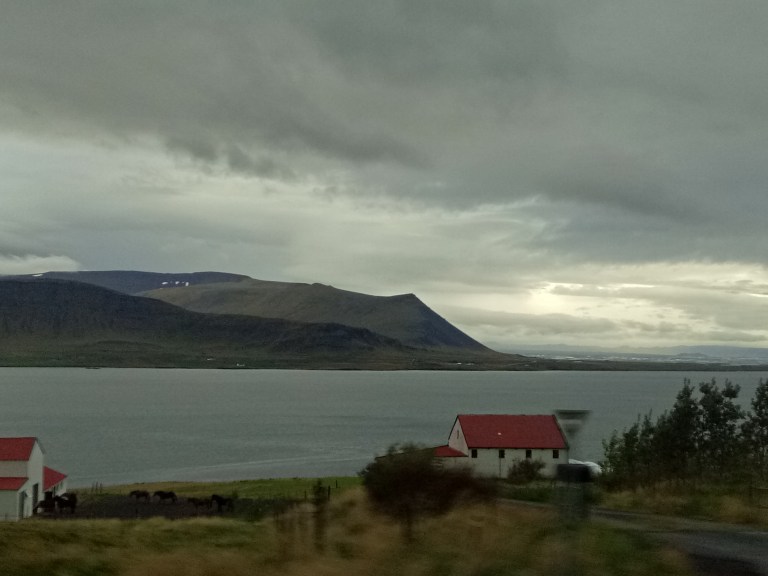
We drive out of town and head north. The entire landscape appears shaped by volcanic lava or glacial ice, which gives you a feeling of watching a prehistoric event unfold. The rain obscures the dramatic rock formations around us. Everything appears wind sculpted. Even the clouds are bulbous and multi-layered – with flattened rims as if a giant had rolled them out like pastry but too thin on the edges, or whisked like an upside-down icecream swirl. We are told that Iceland is a land of fire and ice, with earthquakes to make it interesting. Apparently, one occurred last night not far away, but I slept through it. We are also told that if you get sick of the weather, just wait ten minutes.
Hórdur tells us via his tiny microphone headset that Iceland has three main industries: originally fishing, from the time of the first settlement, was the biggest and still is major – all the coins have fish symbols; then with cheap electricity thanks to geothermal hot springs, heavy industry in the form of aluminium smelting was second biggest. Tourism was third but, according to many, an event occurred that put Iceland on the map, so to speak, and changed tourism to the primary industry it is today – thanks to the April 2010 eruption of volcano Eyjafjallajökull (it is a mouthful) which halted many flights into and out of Europe. I distinctly recall that eruption. I had been volunteering in Togo, West Africa and I flew home via Paris, so I left Europe the day before it happened and landed in Australia to all the news, thinking myself extremely lucky to have not been stranded. Apparently many Icelanders thought that the eruption would kill what there was of the tourism industry but it had the complete opposite effect. Apart from tourists, there are different sites for seeing where films and television series have been filmed here, among which are Interstellar, a couple of Bond films, The Secret Life of Walter Mitty, Prometheus, as well as some of series 4 of Game of Thrones.
We have a quick toilet break at a service station before driving on. They sell ‘hard fish’ (hardfiskur) as a snack. It was used as currency in the old days. I am tempted to buy it just to try some Icelandic food, but the idea of chewing on fermented dried fish outweighs the temptation.

I talk with Hórdur while we wait for the others. He is probably in his late 60s, tall and thin, with a wife and grown family. His voice has a melodious lilt, with plenty of pauses while he thinks of the best way to express himself; it is quite a lovely calming feeling listening to him. The wind is cold enough to make my braces feel frozen against my teeth when I smile, and I feel some small pellets of heavy rain hit my clothes. I should get back in the bus before I freeze, but his tranquil nature keeps me there. He is not into small talk, but our chat is mostly about the weather – another trend, I’m told – and when he points past the storm front to where there is a break in the distant clouds and blue skies beyond, smiles broadly and with eyes crinkling says, “That is the way we are going”, it makes me laugh.
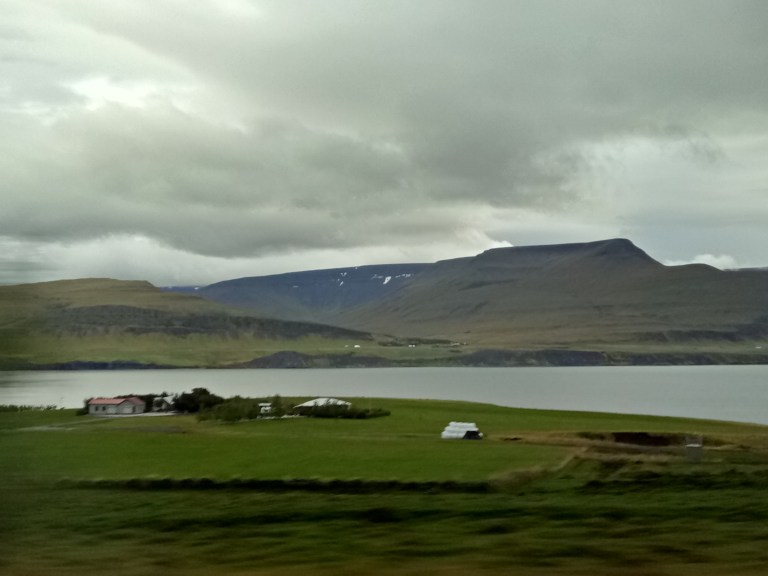
As we travel I am silenced by the raw beauty around me.
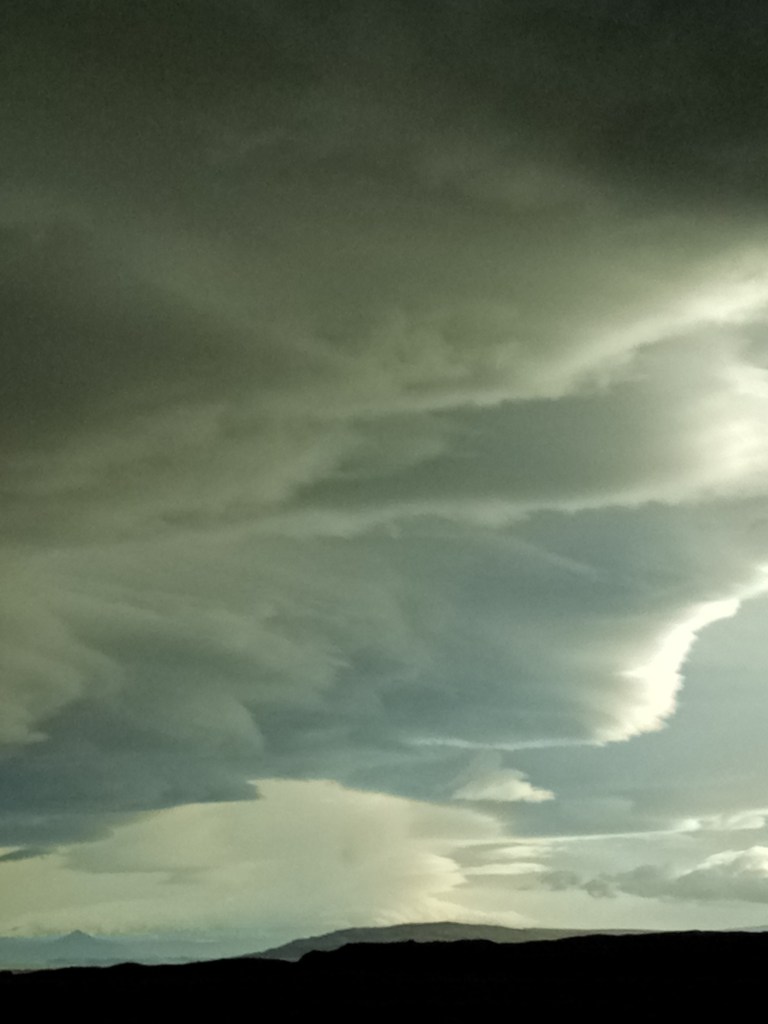


We stop briefly at some geothermal springs. It is only in recent years (early this century) that geothermal energy was used as a source of supply for heating of homes and creating electricity. The springs are interesting but it is the sky that still captures my gaze.


Eventually we see glacial lakes and rivers and the moraine debris – our glacier, Langjökull, is close. We arrive at a small shack and here we put on more protective clothing – overshoes and waterproof one-piece suit – before climbing up into a machine that has been re-purposed from German missile carrier to glacier transport. We will be driving up onto the glacier!


It is a slow process, which is good, as the wheels dig into the topmost layer of glacial ice and we shudder our way from horizontal to 45 degree angle up onto the glacier. After about 20 minutes we arrive at an enormous hole that has been cut into the glacier. It is the entrance to the tunnel which has been carved out of the ice over a period of a few years, and that is where we are going – INSIDE.


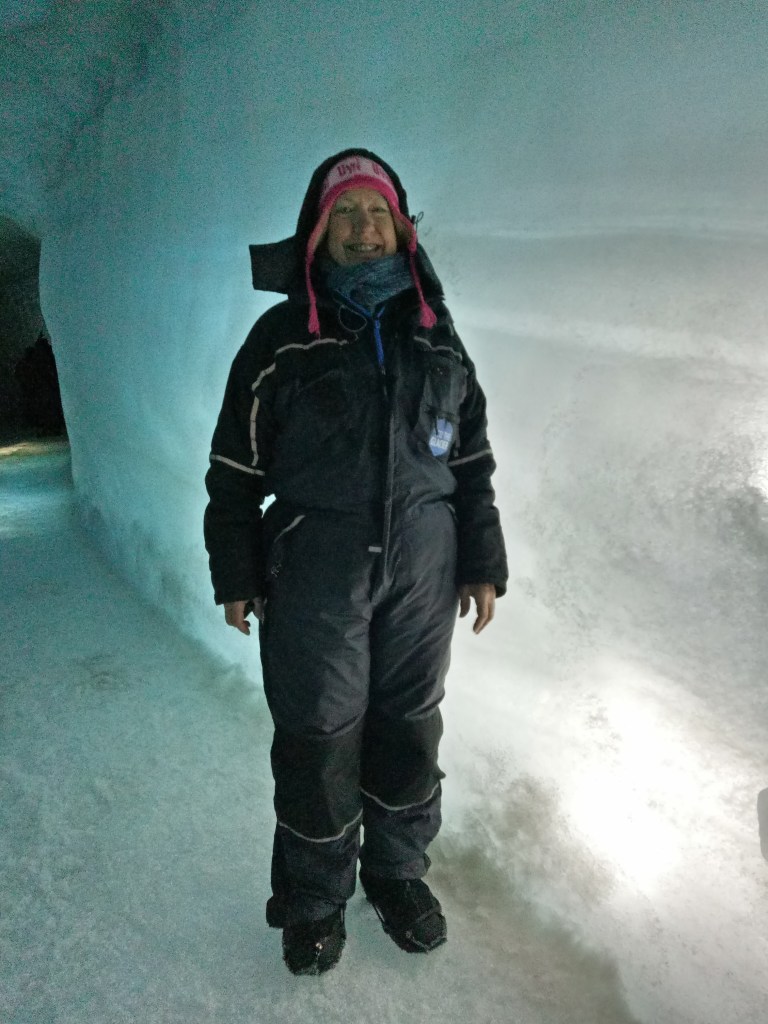
Not long after we enter we have to put on crampons over our shoes and crunch over the ice in the passageways. I am so excited but it is a bit freaky walking along knowing that there is x amount of snow and ice over your head bearing down and maybe crashing through at any moment, yet it is also spooky. We walk in a hush behind our animated guide who loves joking with us and quizzing us on how to say Eyjafjallajökull. She informs us that this glacier will have disappeared in about 80 years and nothing can stop it from retreating and melting, a sombre thought. She also informs us of the scientific benefit of having the glacial tunnel built.
I feel amazed to witness this rare thing – being inside a glacier.
She points out the age years within the glacier and when an ash cloud from the 2010 eruption covered the glacier changing its colour.
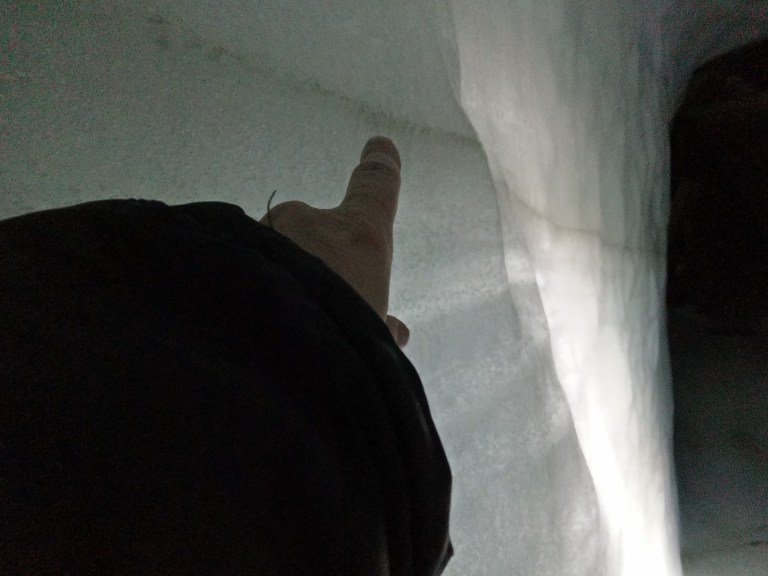
The further we go in the more the tunnel is lit with artificial lighting. We stop for a moment to try glacial water that is travelling underfoot, to listen to our guide sing an Icelandic lullaby inside the chapel – a hauntingly beautiful moment – and see up close a crevasse that was hit during tunnelling. I am spellbound.


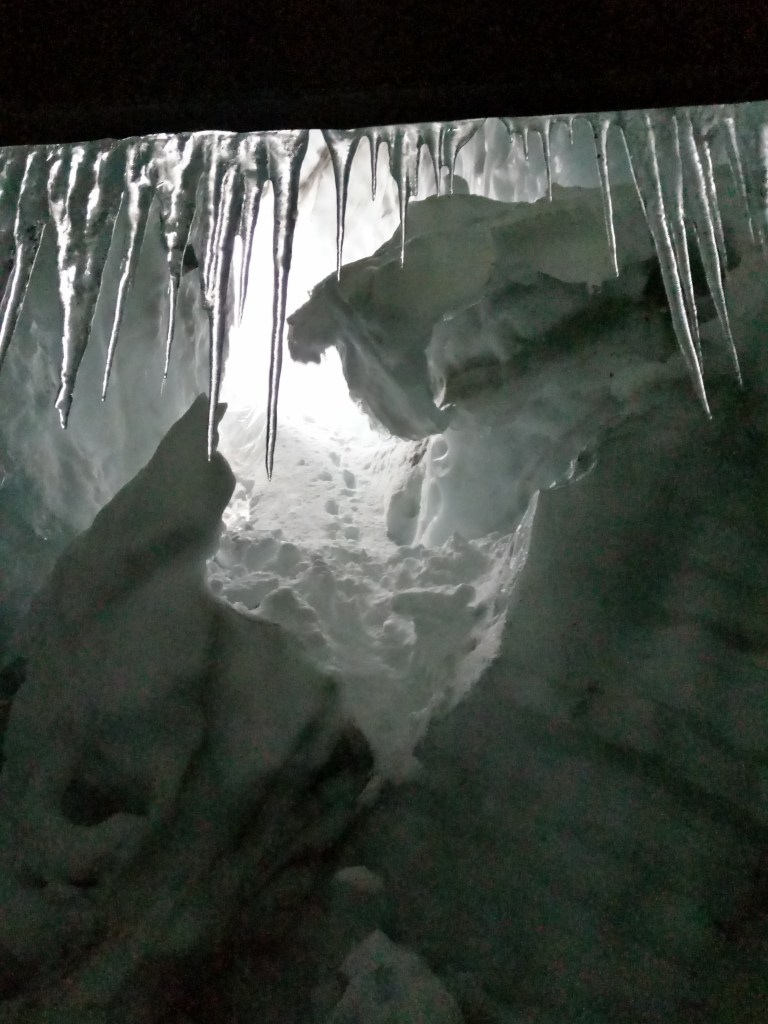
After about an hour it is time to re-emerge into daylight, into snow! One of the Americans from our group makes me a small snowman as a joke.
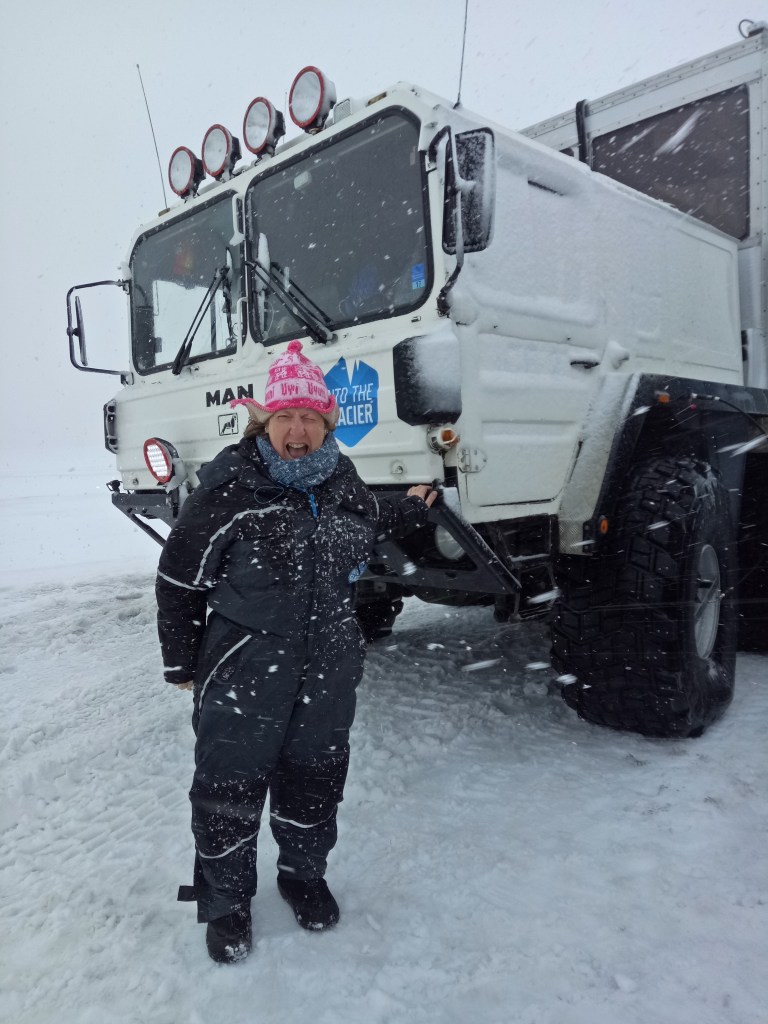
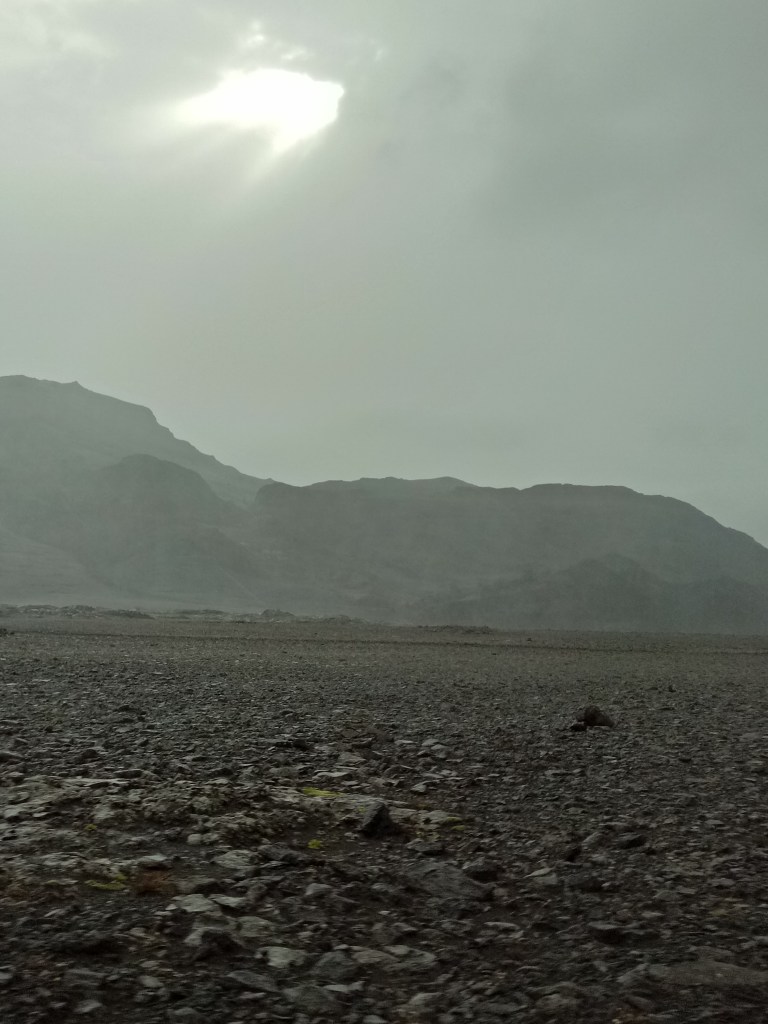
Once again we are at a 45 degree angle on our way back to the hut, where we change and re-board our warm bus. The storm that brought the snow to us on the glacier means the sunlight is struggling through, creating interesting and moody views as we continue on our way. I don’t know if it was, but I can imagine scenes from Prometheus being filmed here; it looks so other-world-like.
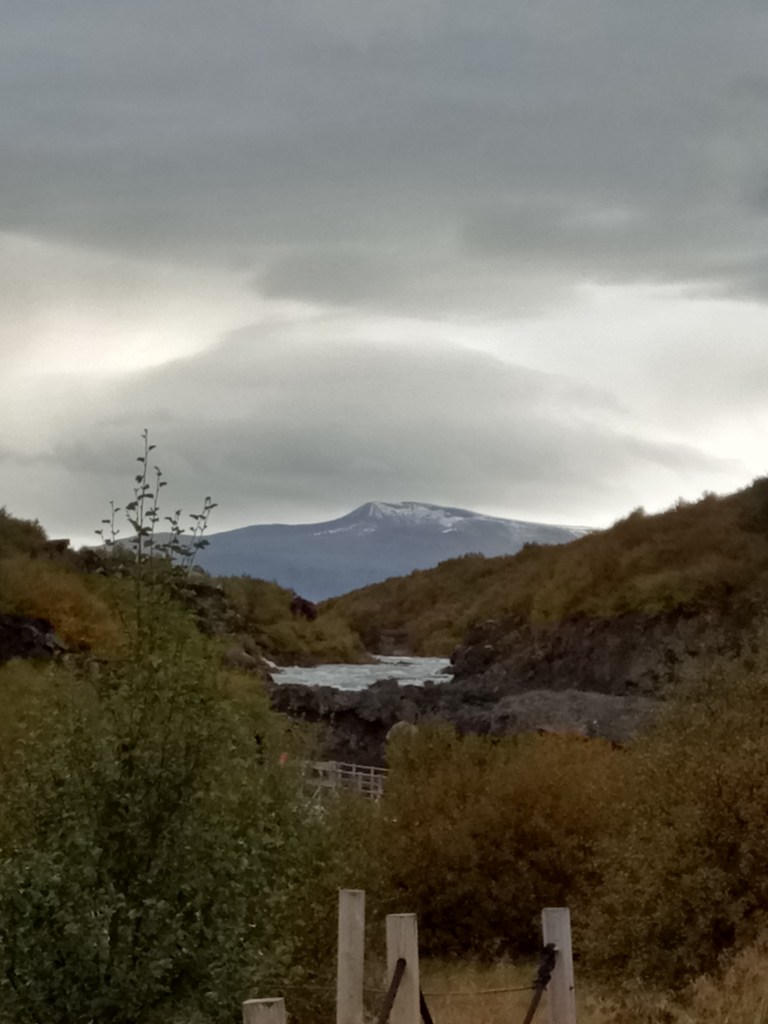
Next is a waterfall that has a sad history. There was a stone bridge over the river but it was taken down after a couple of children were drowned here long ago. It is a beautiful spot. But each place has a story or folktale associated with it, which adds to the richness, I feel.


Unfortunately our day is at an end. The sky clears a little as we return toward town. I have been drinking in the views today, my first day in Iceland.
I feel so fortunate to be here experiencing this place.
 Jen's Magic Carpet Ride