
Music. That is what I think of when I think of Athens.
Bon Jovi’s Bad Medicine is blasting in my eardrums from overhead speakers. I’d say the owner is into heavy rock as I am subjected to a range of it while eating. I am a captive audience, after all. I am sitting in a Greek café in Athens having some Greek fast food – chicken served with the ubiquitous bread with drizzled olive oil and salt.
Something else that I find ubiquitous in Greece is the large number of men sitting drinking coffee in cafés and playing backgammon or smoking, watching people walk past. I am glad that the mobile phone has not usurped the humble backgammon game here, but all these men in sitting around makes me wonder where the women are, and are these men not working? Regarding smoking, I need to get on my soapbox for a minute. All over Europe smoking is still tolerated inside cafes and restaurants. It was not the case in Australia and where I travelled in south or north america. I’m looking at you specifically France, Italy, and Greece. So, you are constantly breathing in and passive smoking other people’s exhale. What century is this? And don’t even get me started on those who vape as possibly one of the most annoying habits, breathing their vapour all over you so you walk for a moment essentially through a fog. In France, I saw school kids gathered outside their buildings on their break, smoking. They looked 13 or 14. In Paris I actually got hit in the face by a woman’s cigarette ash as she breezed past me unawares (I’m talking about you lady, in the gorgeous navy blue trench coat and high heels that I would die to be able to wear with as much French panache as you). I understand that smoking in these and other countries is kind of a lifestyle thing. Maybe it’s considered sexy or cool. And I know that everyone is entitled to do what they want with their life blah blah. I get it. But. People, dying of cancer is not sexy or cool!
Rant over. Back to the music.
Even on the bus to Athens from Meteora, the bus driver has the radio on traditional Greek music (though occasionally Neneh Cherry and Phil Collins – what a mix). Once again I was a captive audience, although I don’t mind traditional Greek music. I am in Greece, after all. I catch a taxi from the bus terminal to my cheap hotel/upmarket hostel in town and the radio is playing. The hostel is modern and well appointed, conveniently close to a metro station, but next door to a place that runs girlie shows and has pictures of half naked women plastered all over its entrance – I can pick them. Once I squeeze myself and my bags into the minuscule lift, I am pleasantly surprised. I am listening to, not elevator musak as I expected, but Dua Lipa followed by Tilted by a modern group called Christine and the Queens whose song I adore. I sing along to it all the way to my room.
In the breakfast room, there is a music channel playing constantly on the television. It plays a mix of modern English-speaking pop (I think Rihanna with Calvin Harris is on repeat) and Greek modern pop. I like all kinds of music (except death metal and country) and am a big fan of modern songs, although I cannot understand the lyrics to the Greek songs but they all seem to be about lost love. After a few breakfasts of watching these music videos, I decide that I could become a pop music video director for the Greek singers. All I need is a drone for overhead shots of fabulous Greek scenery no matter what the song’s storyline, for the male singer to be attractive with a sculpted three-day-growth, for the women to be tall and slim with long flowing hair (I am so glad they are not wearing skimpy outfits like so many music videos these days although, one time, I do see a female singer wearing a one-piece very high cut leotard thingy with a white line where her G-string blocked the fake tan. Just, why?) and for each shot of the story to be in slow motion. Every. Single. Shot. In. Slow. Mo.
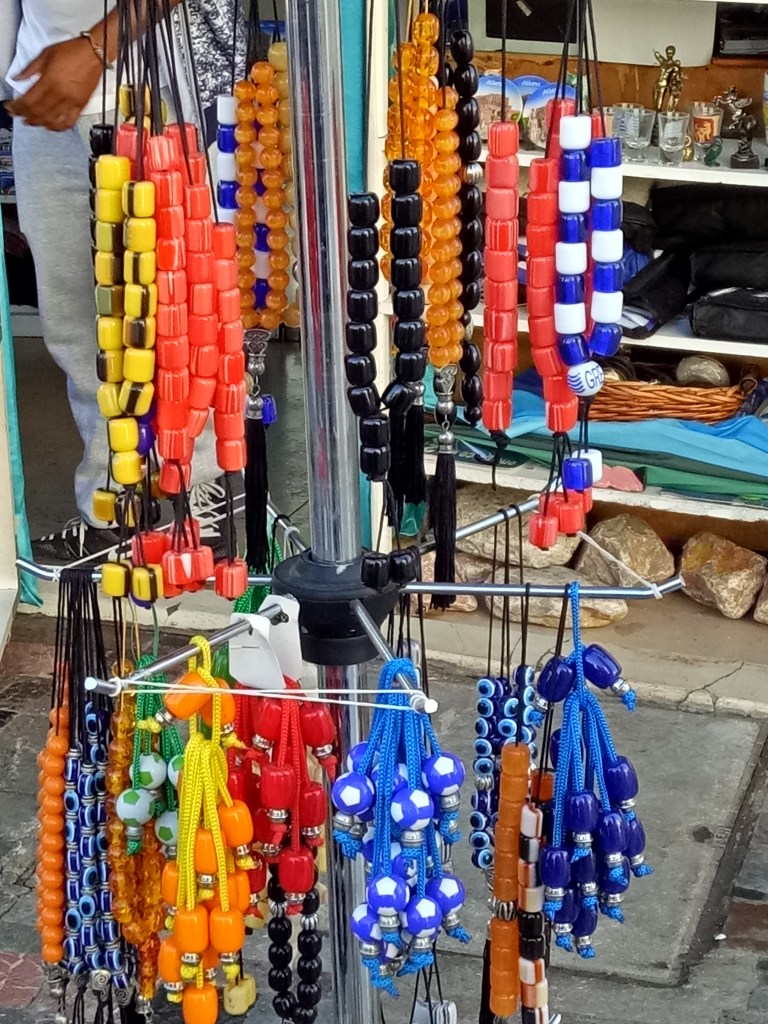
I am eager to get among the ruins. I walk about a kilometre directly south, passing markets filled with fresh produce where birds in cages accompany my walk with birdsong, and through a square fronted by restaurants and souvenir shops (so I must be close). The bright colours of the worry beads catch my eye. I see only men using these, flicking and clicking them through their fingers – though I wonder what they have to worry about if they spend all their time in coffee shops. These and the clack of backgammon tiles add to the Athens background soundtrack.
Suddenly I glimpse the Parthenon up high in the distance backlit by the morning sun. Hadrian’s Library is to my left, Ancient Agora to my right, and up ahead, the Acropolis. At Hadrian’s library, where many ancient manuscripts and scrolls were housed, I am confronted by a large, white, wolf-like dog that reminds me of Game of Thrones direwolves. But he rests, unmoving on the marble steps, almost as if he were part of the original buildings and had been lying there for centuries to eventually become stone.
I am amazed by how many Greek ruins are still left around, and how the city seems to live right beside them but without impinging on them; an example of living with history.




Agora means a large, open meeting or gathering place (hence, the term agoraphobia, meaning a fear of crowds or open spaces) and this area, Ancient Agora, is dedicated to numerous buildings used for different public needs such as worship, marketplaces, a dais for public speakers to vent their feelings, schools of philosophy and thought, a gymnasium, monuments, a mint, and the list goes on.
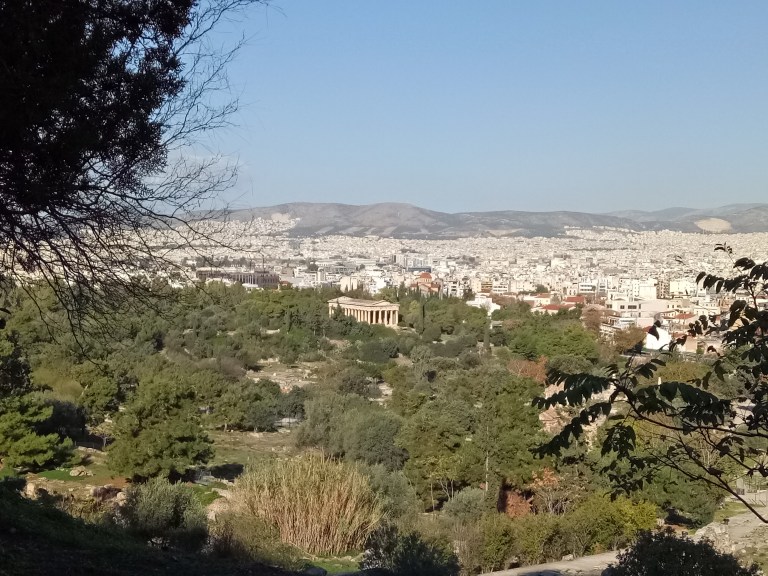
The temple of Hephaestus in the park of the Agora looks like the classic architecture that I expect is similar to the Parthenon. It stands out within the ruins of what’s left of the Agora, amid trees. From it you can see the outline of the Parthenon up on top of the hill in the near distance. From everywhere in Athens it seems, you can see the Acropolis if you just look up.


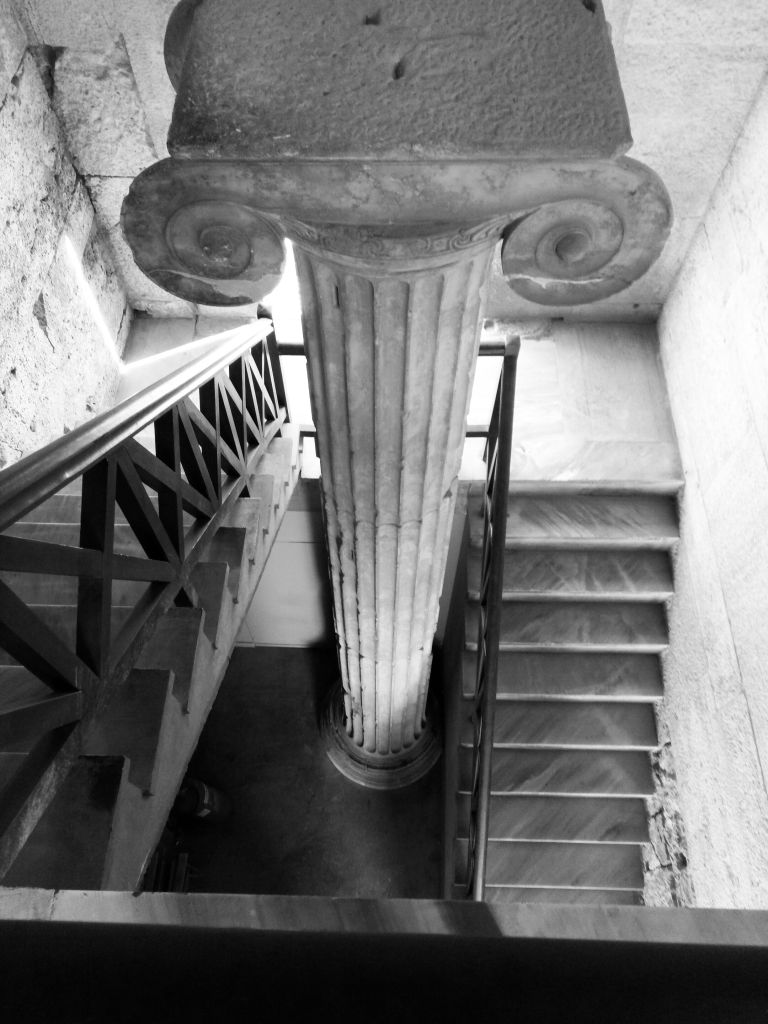
As I walk back through the area I pass multitudes of Greek teenage schoolkids. How cool would it be to learn about ancient Greece then go on an excursion to the see the real thing? The stoa of Attalos is a reconstructed replica of a public space; currently a museum. Apparently it was used as a colonnaded, covered walkway but it seems quite elaborate to be just a walkway. To me, it appears to be a hall that resembles a marketplace – open and airy like a modern shopping centre or mall. What is remarkable is that it is fully rebuilt using ancient methods of construction. It is quite impressive.


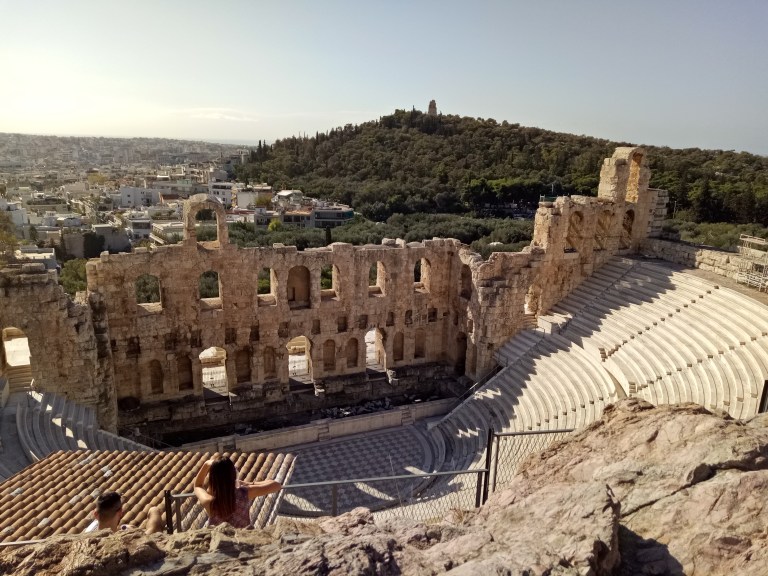
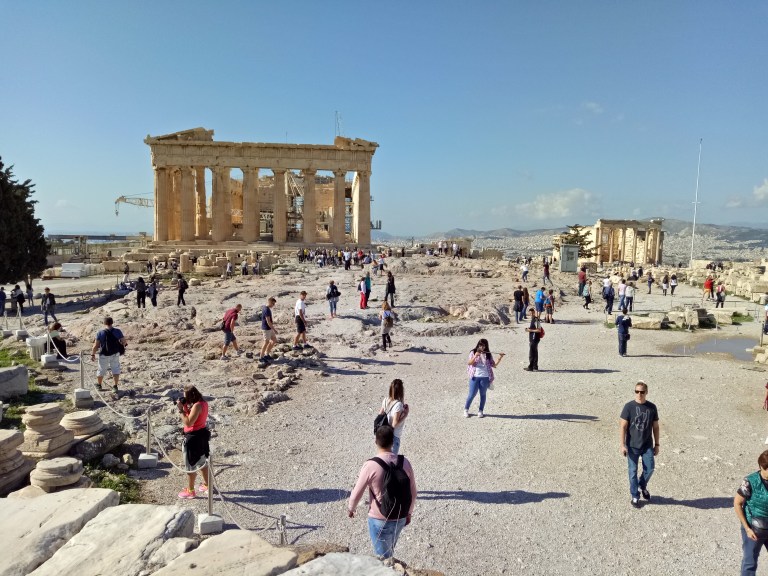
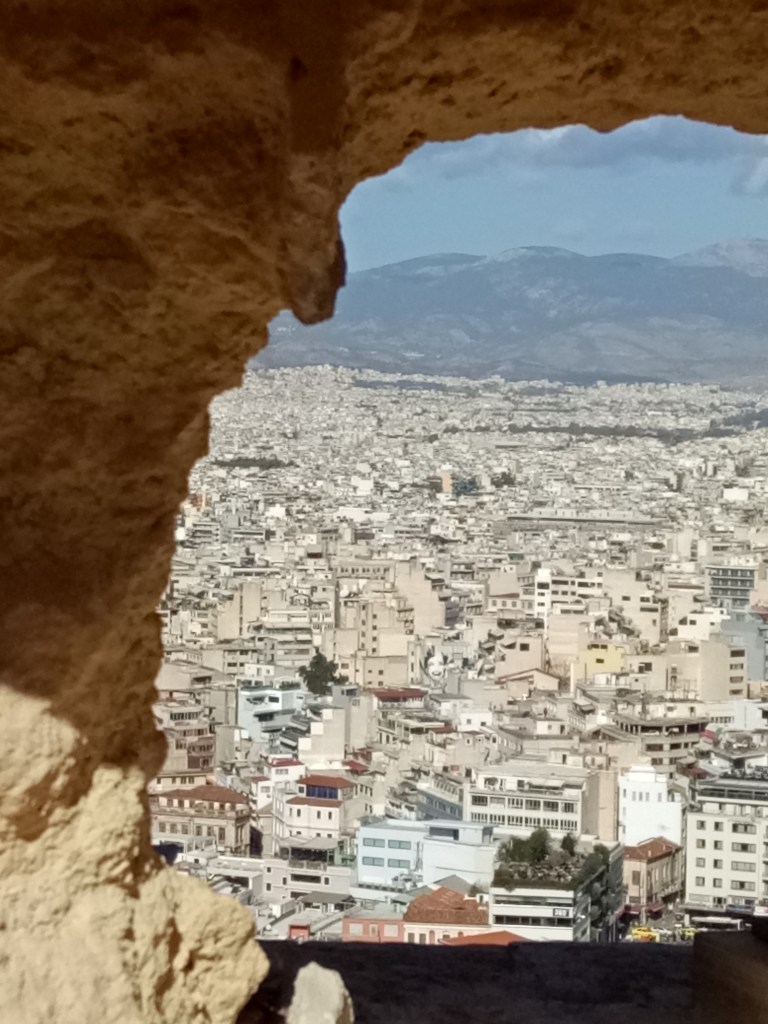
Now for the pièce de resistance, the Acropolis. As I climb the western slope near the entrance I can hear music – an invisible trumpeter is playing jazz. Once I pay for my ticket I follow the crowds (I cannot believe how many tourists there are as it is officially Autumn) up the worn marble stepping stones to a view that overlooks an ampitheatre with a magnificent backdrop of modern Athens shining in the sun.
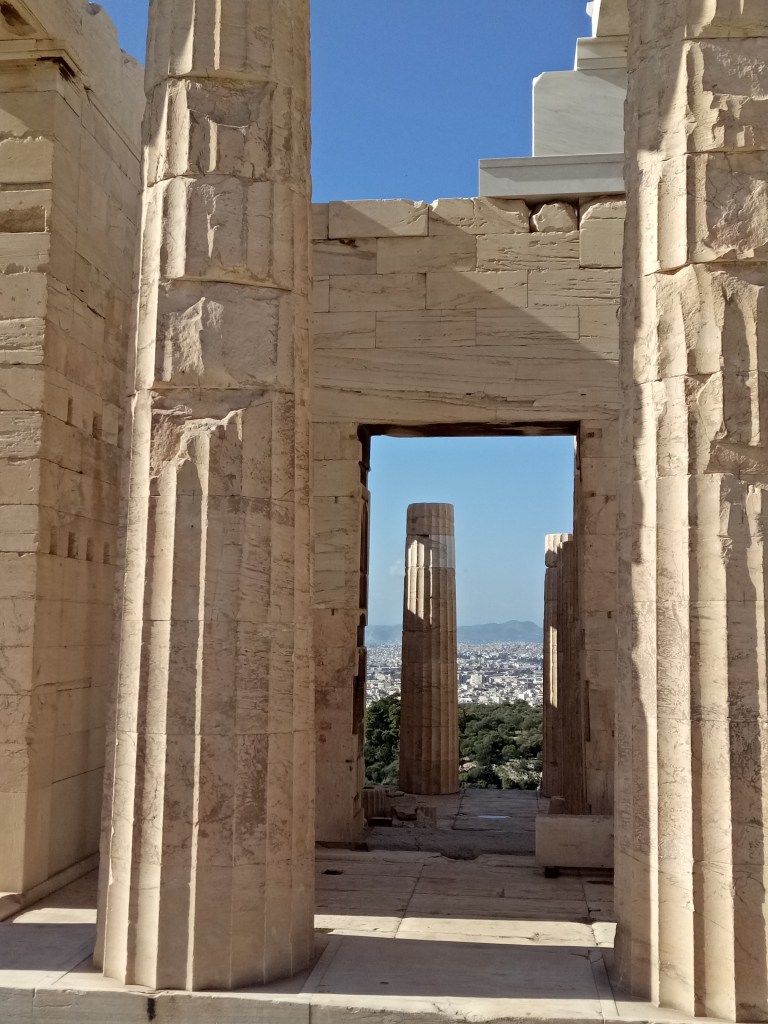
But the Parthenon is calling. I tear myself away and follow the signs up and up, through an enormous carved stone gate, my excitement pushing me faster, until I am on level ground and there it is in front of me. I am here, on top of the world. WOW!
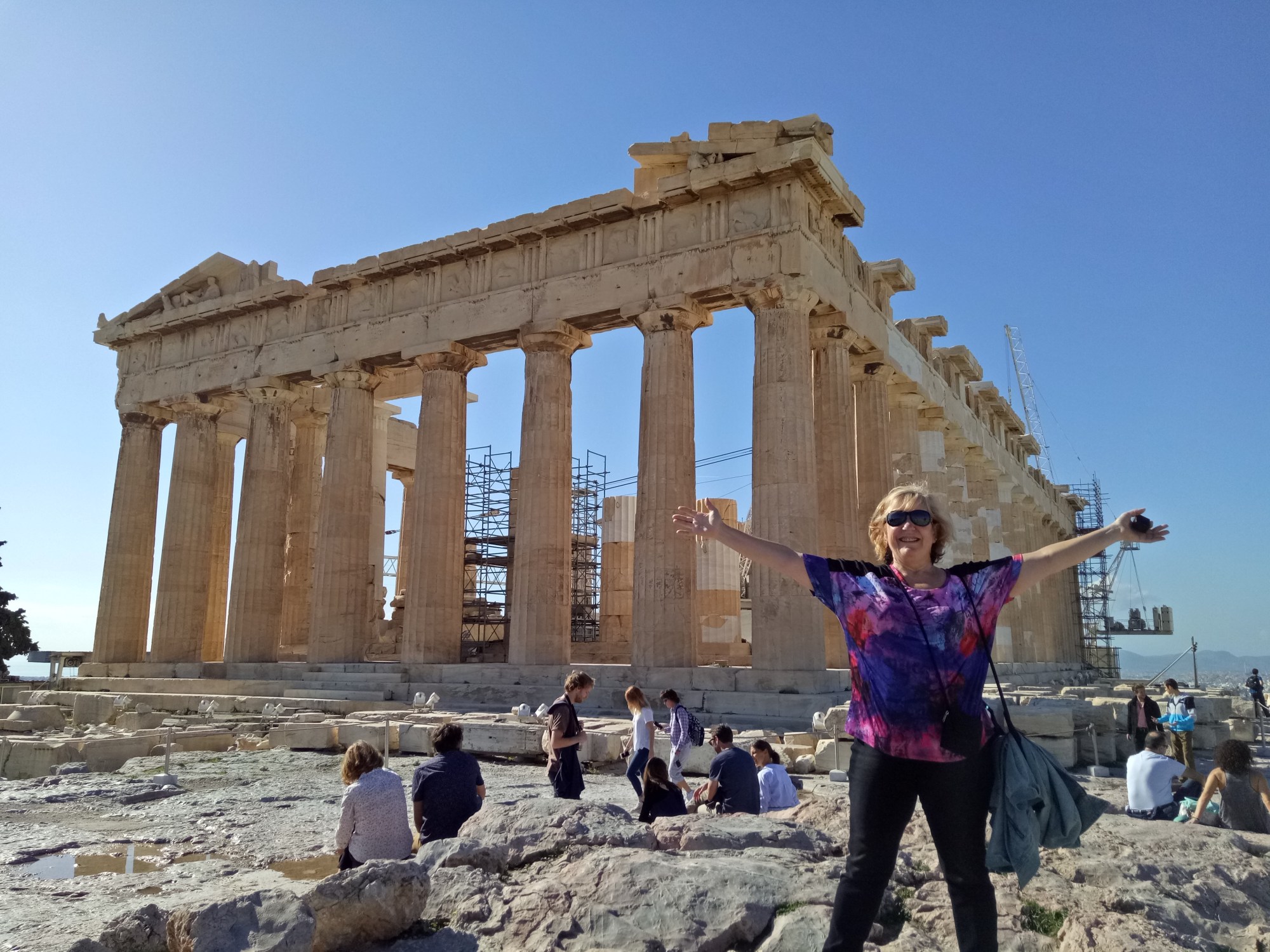
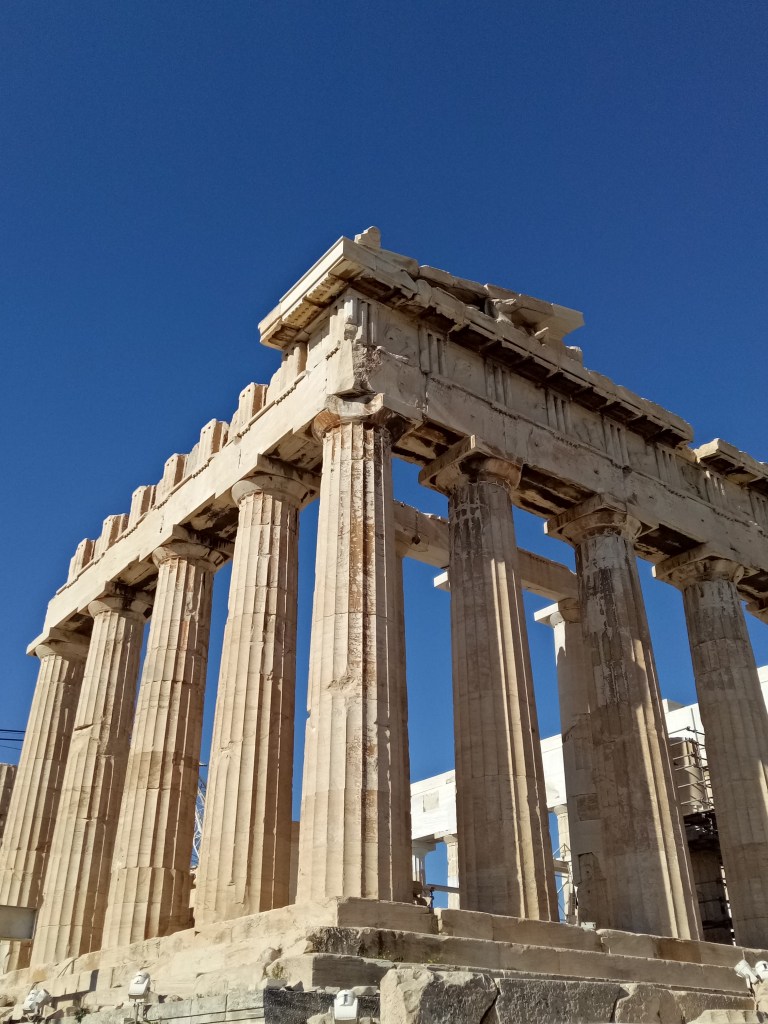
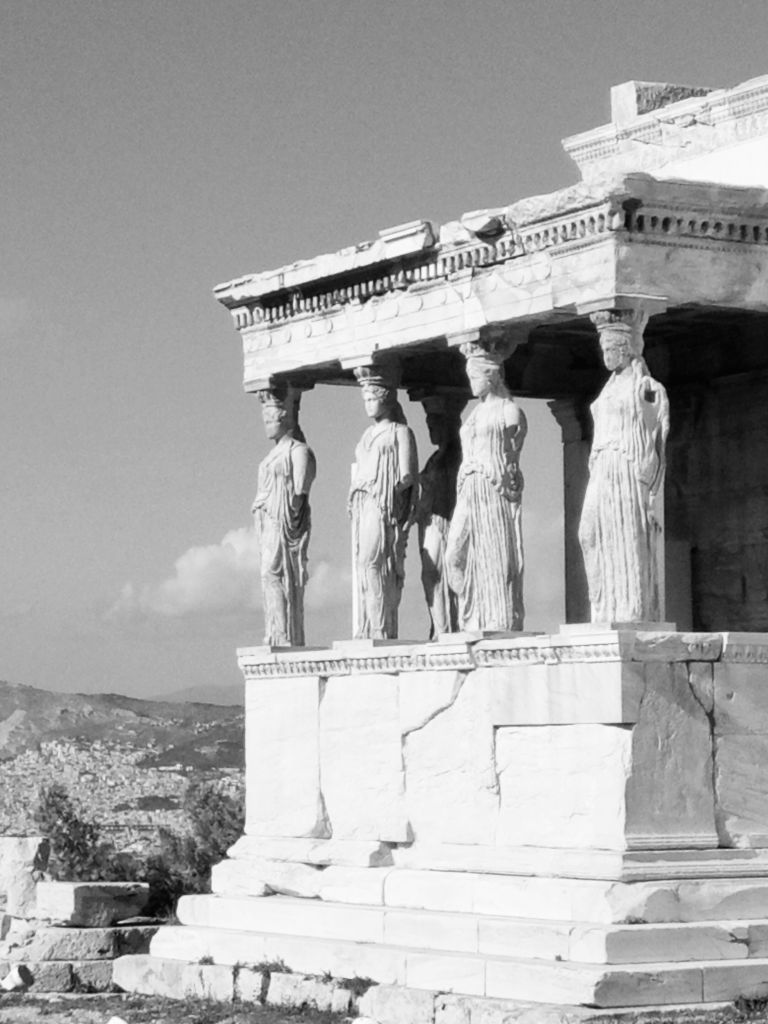
To me, the Parthenon is Greece, and represents the Ancient Empire that gave us so many things that we use in our modern world – just ask a Greek and they will proudly tell you. As I have seen all over Europe, it was a temple, later turned into a church, then a mosque, and now a monument. Built over a ten year period in the 400s BCE, it has lasted the test of time surviving not only an explosion after being used as a site for ammunition storage in the 1600s which exploded causing damage, but also the modern day scourge of tourism – unfortunately, me included. Like many unique things in our world, it has been used and abused and, much later, appreciated and cared for.
I cannot decide which part of the hilltop to look at first. All around me is modern Athens, as if the Acropolis is like the central pivot of an enormous wheel. Indeed, it was the centre of Greek life, with worship in the temple of the Parthenon dedicated to the goddess Athena after whom Athens (ATHNA or AθNA) is named. I spend two hours up there, marvelllng at the architecture, the restoration (inside the Parthenon is inaccessible due to ongoing work), the view, the story, the antiquity, and the sheer defiance of this expansive space to stay put, to stay standing. I am awed.




Modern Athens beckons. I exit via the southern slope, pause at the Theatre of Dionysus, then follow numerous winding backstreets filled with tourist shops through the suburbs of Anafiotika and Plaka, until music draws me to a pretty flowered walkway under which two young men are playing accordions. A waiter, an older gentleman, from a nearby restaurant is moving to their melody. He spies me watching him and gestures to me, “shall we dance?” I agree and step forward with a smile, and let him spin me round and round for a few moments. When we stop I am laughing. He smiles and bows a thank you. He asks where I am from. When I tell him he says, “ah, Greeks and Australians are friends!” and proceeds to give me a hug. As we finish the hug, he holds me away from him without letting go of my shoulders, looks at me earnestly and says, “Thank you, thank you, for coming to Greece.”
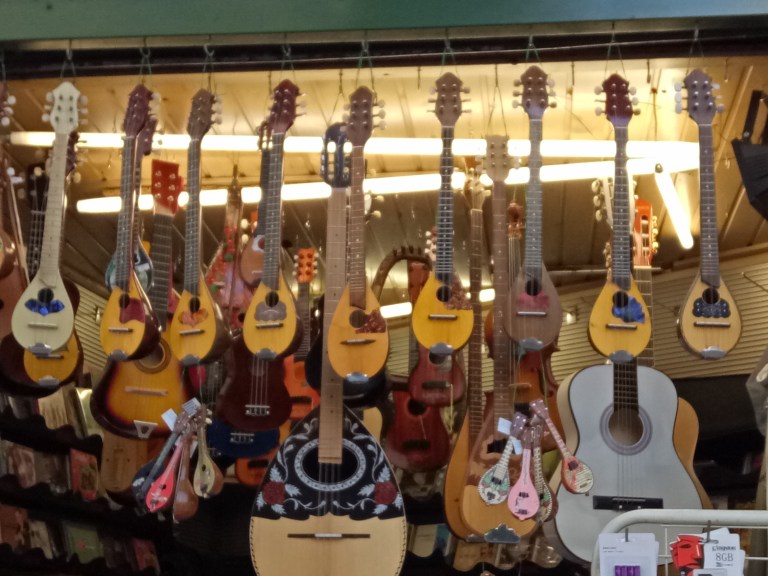
A little further on, I find a small taverna whose chairs spill onto the footpath. In a shop opposite, balalaikas are strung up on display and Greek music is playing along with a video of the arm-over-arm traditional dancing I have seen before. I rest and have a snack of my favourite dip, taramasalata, and a beer.


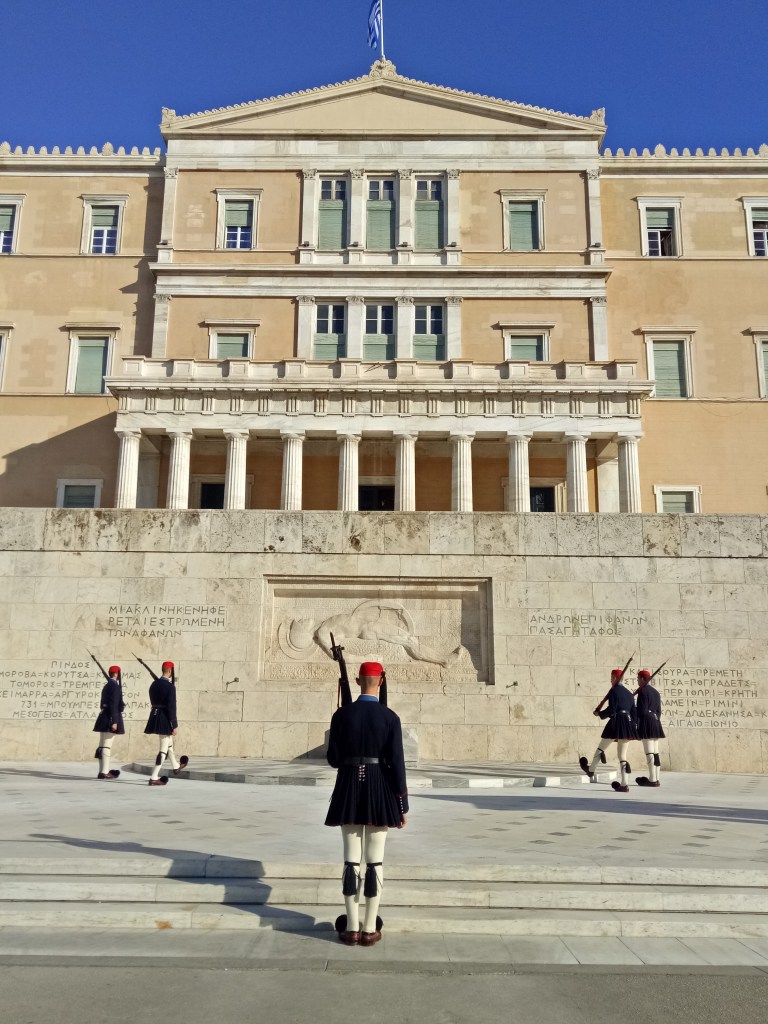
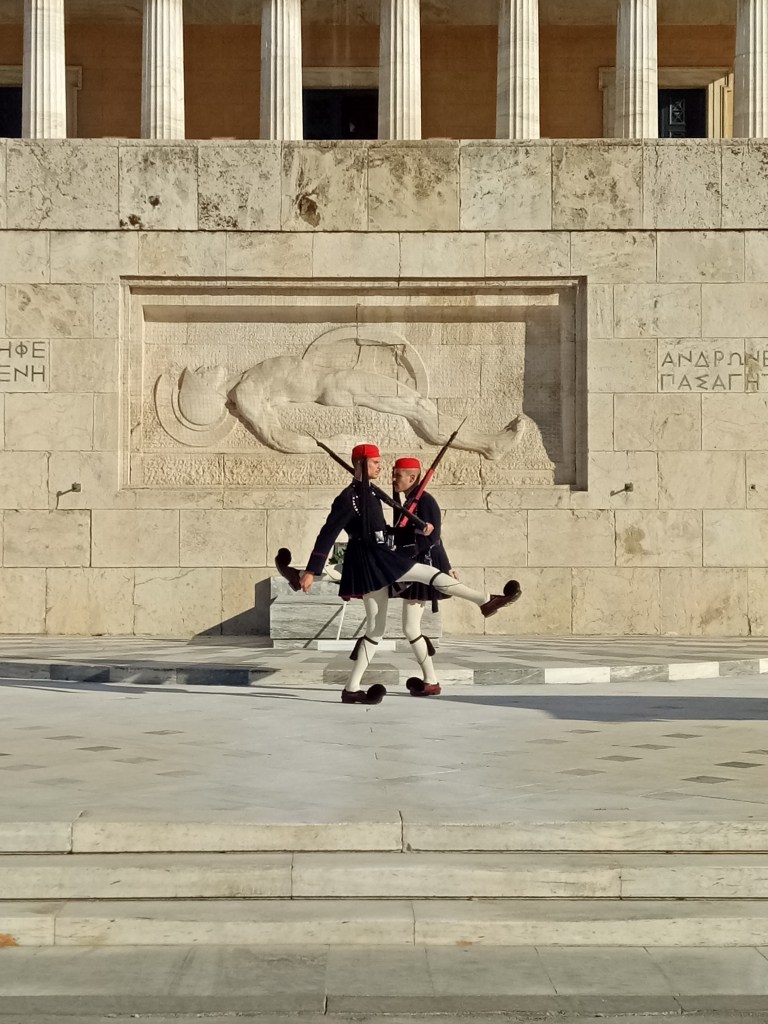
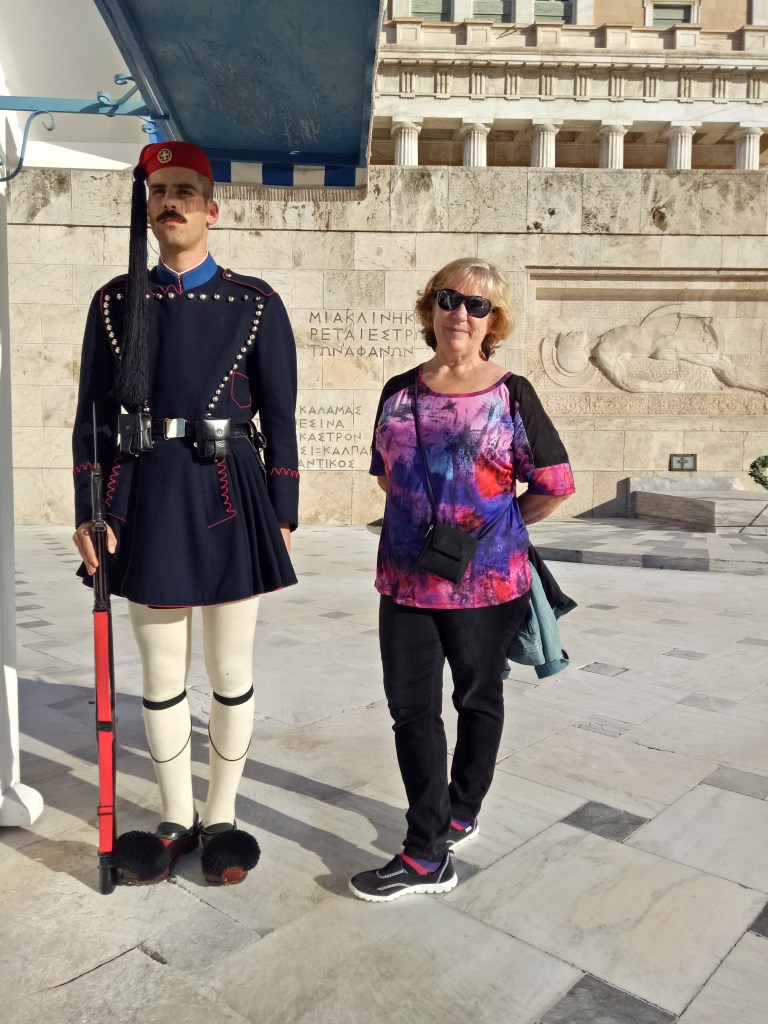
Next, I wander past modern fashion stores with internationally recognisable names to Syntagma Square in front of the Greek parliament and the tomb of the Unknown Soldier. I am here to watch the changing of the guard, a ceremonial display carried out by soldiers in traditional uniform. Once they go through the procedure, they must stand completely still for the duration of their watch. It is like observing a precise ballet, with specific timing, steps, and positions. I feel sorry for the guards because, even though it is early November, it is quite sunny and hot. It is quite remarkable to be able to witness this unique and idiosyncratic Greek ceremony.




After the show, it is a relief to leave the heat and return home on the subway. As time goes by, I am improving my understanding of the Greek language and have mastered good morning (sounds like kalimera) and good evening (sounds like kalispera) and thank you (sounds like efkaristo). Also, the symbols are getting more familiar and easier to decode, and I can read most place names which is helpful when on the metro. Although most metros are similar, try reading or translating ΣΨΝΤΑΥΜΑ or other lengthy words. As I descend to my platform, I can hear classical music playing somewhere from the depths. Long hollow corridors of suburban metros tend to have great acoustics. Once I am on the train, I can hear accordion music approaching. A woman is playing for tips. Her young son precedes her through the train carriage holding a plastic cup.
Athens = music. It is a constant background soundtrack to the city.
I happen to be in Athens when there is a marathon on. Lots of international accents and the ubiquitous MAMILS (middle-aged men in lycra) gather in groups inside the hostel. I meet two competitors – one before (Josh) and one after (Britt) the race. The modern day marathon is of course based on the story of a runner, Phillippedes, carrying a message of victory in war in Ancient Greece who ran the distance from the town of Marathon north-east of Athens to Athens, delivered the message and promptly fell down dead. It is now a standard 42 miles (67 km in real measurement). Kudos to all who participate; it is a huge effort of discipline and training.
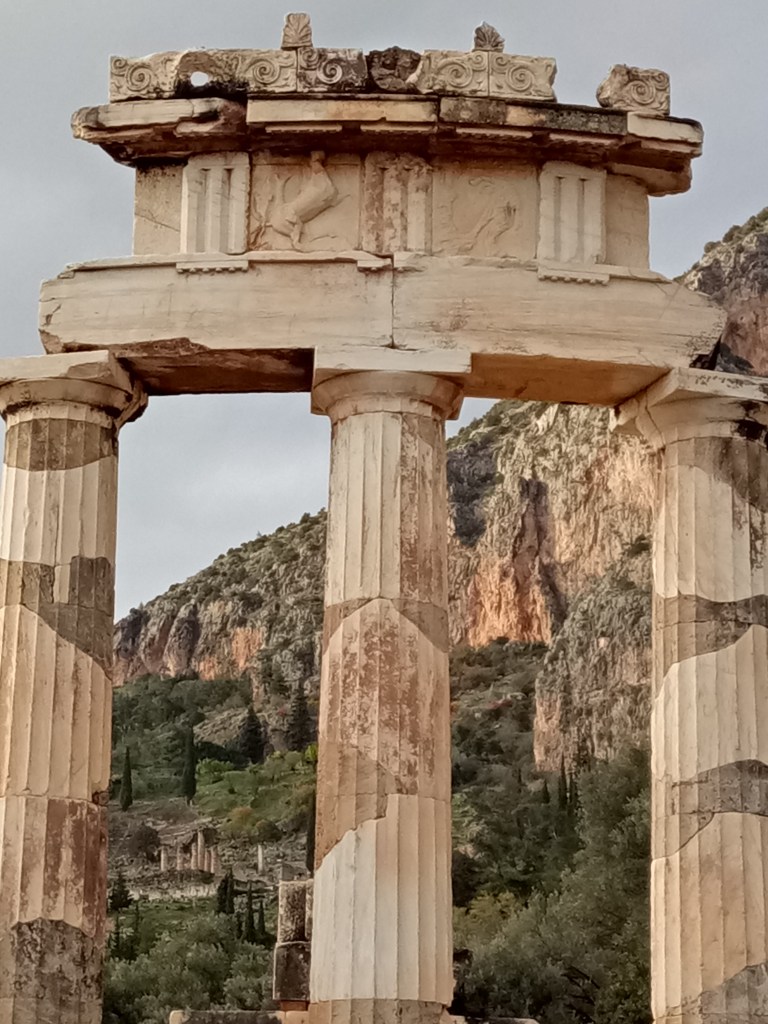
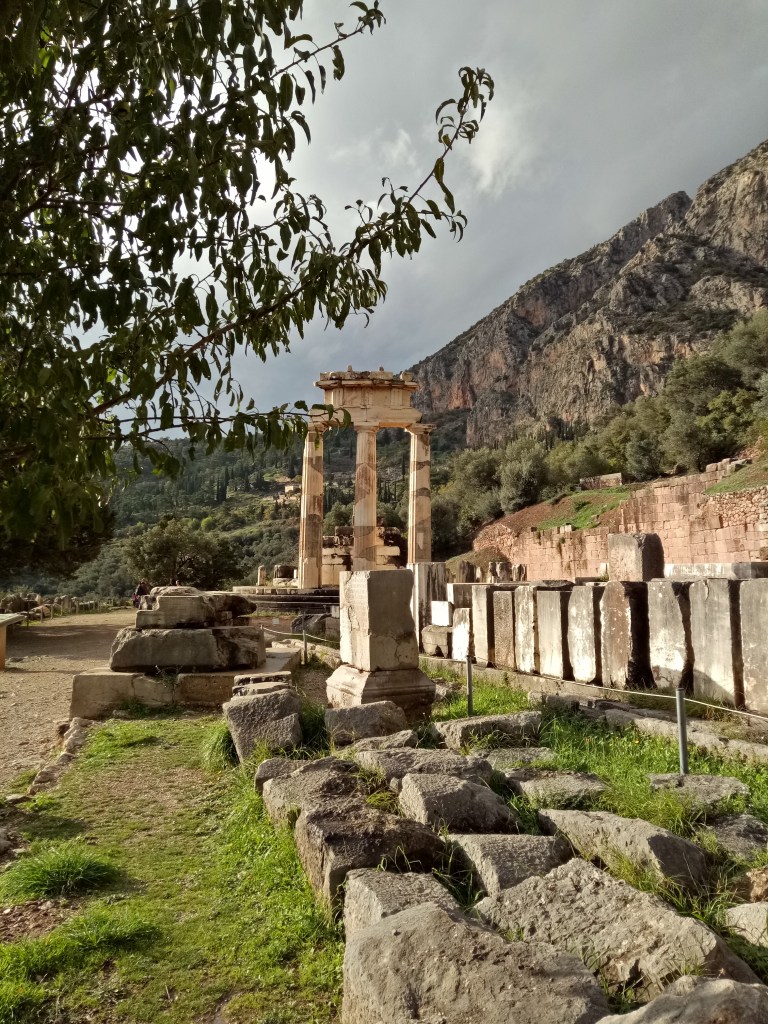
On my last day in Greece, I decide to bus it to Delphi or ΔΕΛΦΟΙ, the famous site of the Oracle whose advice was followed by peasant and emperor alike in Ancient Greece. It is a few hours north-west of Athens in a mountainous region located on the steep-sided Mount Parnassus. The site was also used for athletic games prior to the rise of Olympia which usurped it. I meet Josh at the bus station prior to boarding. He is a lovely American guy with a good sense of humour and is great fun, and he is travelling with an older Korean man that he just met, mysteriously known only as Mr Lee. It’s only later I find out that Josh is running the marathon the next day. I also meet Steve and David from U.K. doing a quick weekend visit to see Delphi. I feel jealous of those who live so close to all that you can see in Europe as it is only an hour or two to fly anywhere. It is about 24 hours to fly to Europe from Australia.
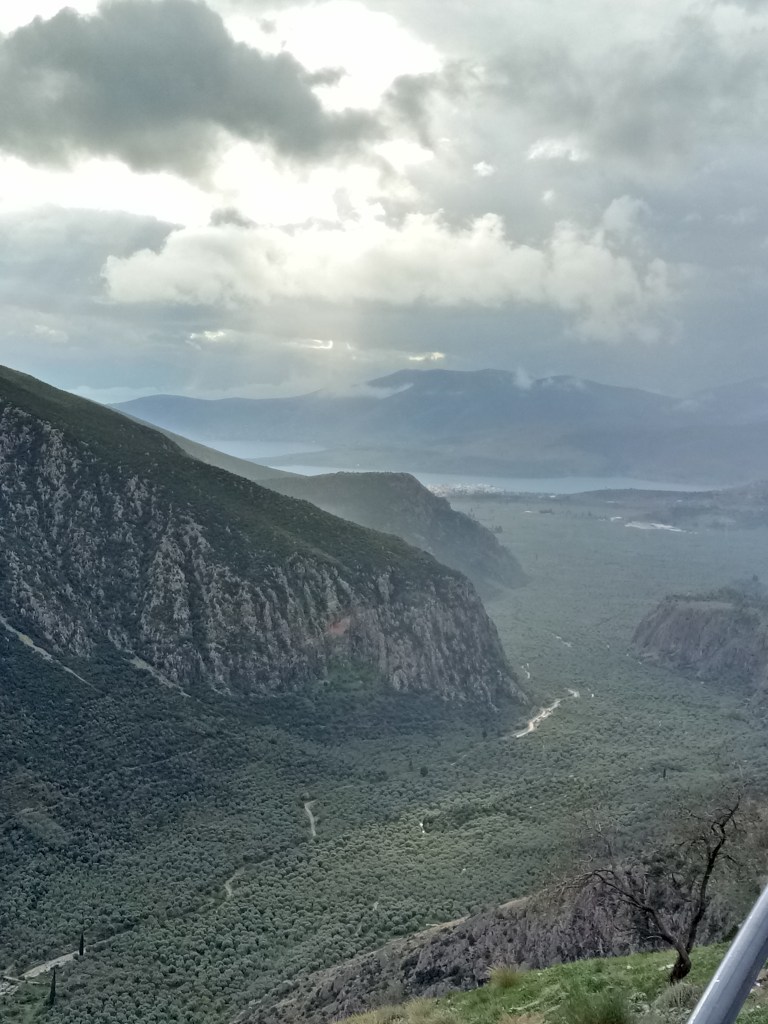
We are all sitting near each other so we all chat on the three hour bus ride, winding through the countryside with steeper and steeper drop offs until we drive past the temple complex and at 1 p.m. alight at the small township which has an amazing view down the valley towards the sea. Steve and David set off for the temple, and we catch up with them later – we are on a time limit as it shuts at 3 p.m. and my return bus is at 4. The three of us – me, Josh, and Mr Lee – make our way to the bigger site first.
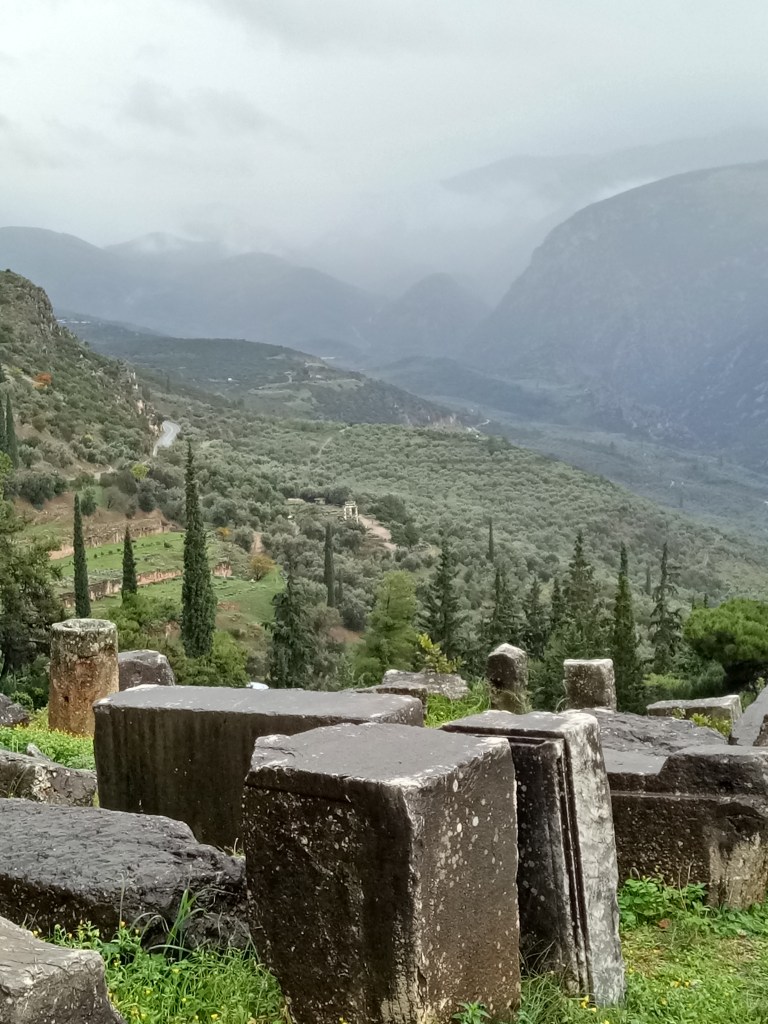


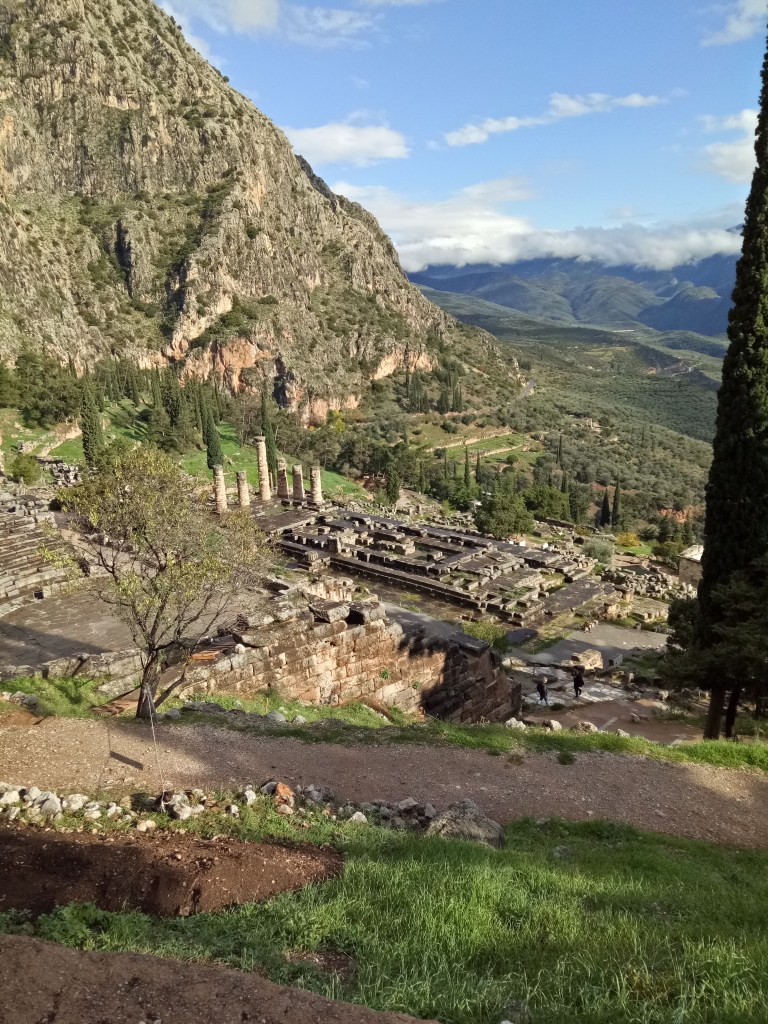
It is strange to walk among buildings that were in use over 2000 years ago – as it was then a thriving city – with a paved road through to the temple, ampitheatre, and stadium, all rising up the side of the hill. The weather is threatening to pour with rain but it clears a little as we walk up the last few steps to the stadium. I can just picture multitudes of spectators seated around the carved steps cheering on the runners or other athletes, and giving applause when they receive their laurels. The temple to Apollo still exists near the ampitheatre used for theatrical performances. We head quickly down the road to the final site, another temple but apparently the one where the Oracle lived. This place has a different vibe, a more calm and almost spiritual one. The clouds clear and the sun comes out to coincide with our visit. I would love to pause here longer but it’s almost 4. I almost sprint back up to town to the bus stop and meet up with Steve and David. Later once we return to Athens, the three of us climb Lycabettus Hill that overlooks all of the city lit up at night – what a wonderful sight – and a great way to finish Athens and Greece.


The next day I hear all about the race and wonder how Josh went. I meet Britt later that night who ran the marathon and is aching all over, craving takeaway carbs in a big way. She comments that it is the hardest thing she has ever done. I think of Josh completing that race and how in awe I am of someone who can push their body like that. He finished in 3 and a half hours.
Speaking of bodies and athleticism, for this post, I decided to neatly combine my book and film reference on Greece. I wanted to read Zorba the Greek but my library has no e-book of it that I can download to the app on my phone. And instead of reading the Aesop’s fables or the Iliad and the Odyssey to get my fix of Ancient Greece, I force myself to undergo a session of watching Brad Pitt leaping around in next to nothing in the movie Troy. I enjoy the fact that they did not seem to get cold in ancient Greece. In the name of research, I put myself through assessing Brad’s rippling muscles, taut torso, and awesome biceps. Apart from the totally unrealistic subplot love story – where a Trojan priestess who devotes her life to prayer and the god Apollo gets kidnapped by the Greeks and falls in love with Brad’s pout, I mean Achilles’ inner demons – the storyline is well-known and based on Homer’s epic poem. It involves a love triangle: Paris, a prince of Troy; a jealous and trigger-happy husband (Menelaus); and a renowned beauty (Helen, queen of Sparta) who runs off with Paris. This brings about the war where the pivotal moment is when the Greeks trick the enemy into thinking they have left but are actually hidden inside a wooden horse, as a result managing to enter the city undetected and bringing about death, destruction, general mayhem etc. This idea of a Trojan horse is also used currently in the sense of a computer virus that enters the system undetected often hidden within another entry system, bringing about death, destruction, general mayhem etc. What a unique concept and successful strategy to use in war, pondering the issue and using different modes of thought to come up with a plan. This is lateral thinking at its best. There is so much the Greeks have given modern society.
That is the end of my Greek odyssey, a story filled with danger, fear, beauty, fun, drama, and comedy. Leaving Greece also marks the end of my European sojourn, having spent two months of my four month trip here. I am sad to leave, but I know I will return. ΑΩ
Next magic carpet stop? Asia.
 Jen's Magic Carpet Ride