
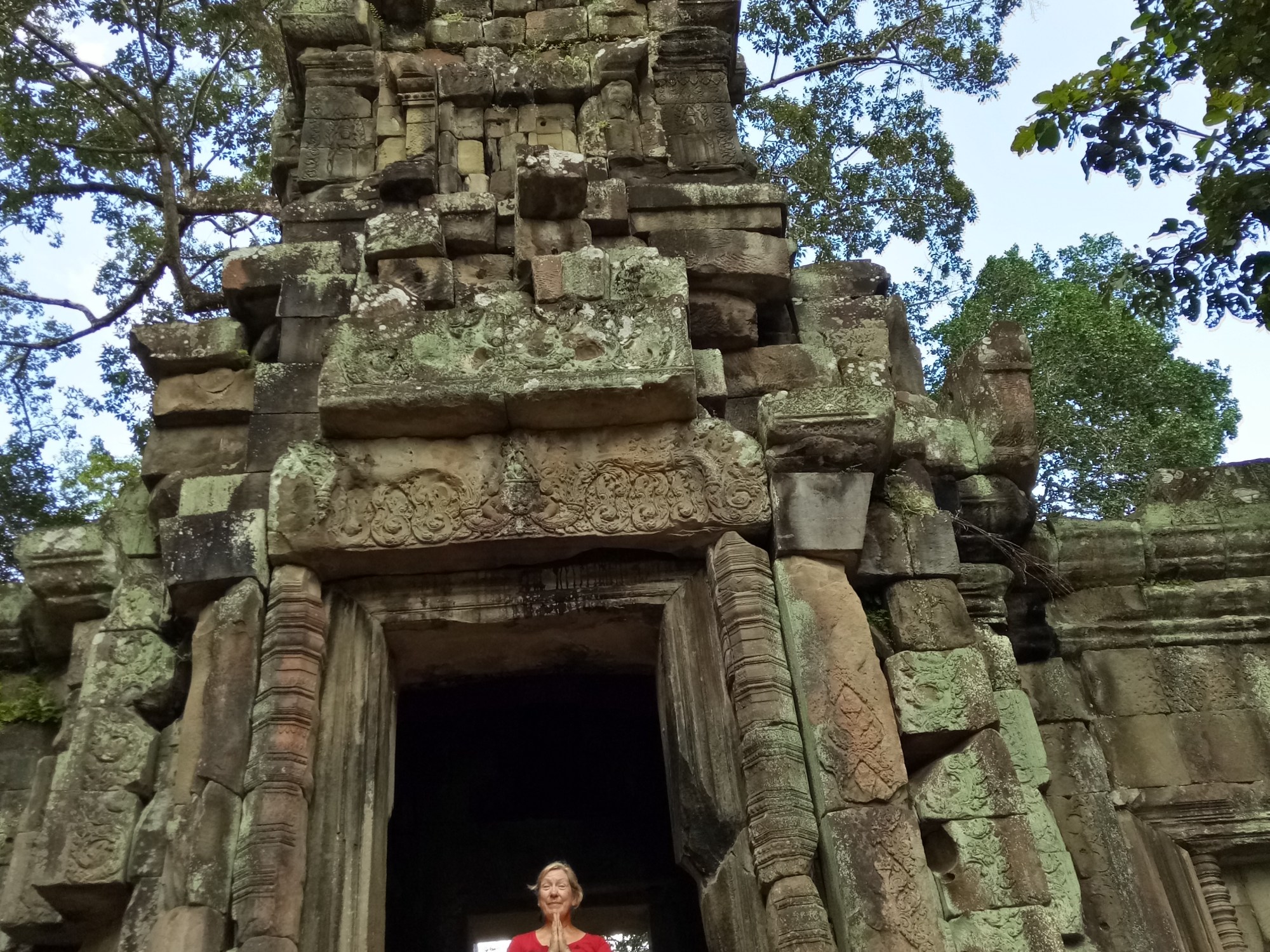
Angkor Wat is one of those mystical places you hear about steeped in legend, with stepped pagodas rising above the steamy jungle and a palpable spiritual atmosphere.
I wanted to see and experience it for myself.
Cambodia is the start of my last leg of this magic carpet ride – Asia. Once I touch down in Bangkok, Thailand (via Lufthansa – great flight) to recover from jetlag before heading across the border to Cambodia, I am immersed in the customary noise, heat, humidity, dust, and chaos you find in most of Asia; a lot of dodgy things take place here that would never pass inspection in Australia and other countries. I have spent a lot of time in South East Asia both growing up and as an adult, so it is familiar territory. One of the first things I see on the trip from the airport, in one of Asia’s ubiquitous minivan shuttle buses, is a whole family speeding past on a motorbike – dad driving, mum at the back, kids squashed in between, no helmets – and it makes me feel not only close to home, but to smile and think fondly, “I am back in Asia.”
I could fly direct from Bangkok to Siem Reap, a town in Cambodia’s north with close access to the temple complex of Angkor Wat, but where’s the fun in that? One of the things I’ve had the luxury to revisit on this trip is slow(er) travel. Instead, it’s public transport again for me – the cheapest and most real way to travel.
I google travel in Cambodia. I am not against Google at all for finding out information. But there is only so much a person can read about a place before arriving and DOING things. I’m a big fan of doing to experience somewhere. In my research of Cambodia, I read warnings that include do not drink the tap water, and more ominously, do not stray from marked paths due to landmines! Cambodia has a tragic recent history of not only the Khmer Rouge led by Pol Pot and his genocidal actions of killing off professionals and intellectuals along with other ‘subverting’ influences (like Buddhist monks) in ethnic cleansing, but also other civil wars and factions that led to the laying of thousands of landmines across the country causing it to have one of the highest rate of amputees in the world (I think Angola’s is higher). This is a nerve-wracking and sobering thought when I take into account that Angkor Wat is within a national park, and I will be walking through it.
The bus from Bangkok takes about three hours to the border with Cambodia. There I have to pay for my visa (USD $30) and get a different bus to Siem Reap, another 3 hours or so. No buses go direct because each country drives on a different side of the road (differing colonisers) but I don’t find this out til later.
I arrive at a transport hub in suburban Bangkok and ask the woman behind the booth’s glass for a cheap ticket to Siem Reap. The lady types into a calculator to show me the price. It will cost 184 Thai Baht or an exorbitant AUD $7.50 to get to the border. I ask if this bus stops at the border or if it stops at Siem Reap? She nods and answers, “ok.” I try to rephrase my question to clarify and use gestures so she can understand me, using a T-shape to represent the word ‘border’. She nods and say, “ok.” I ask if any bus goes to Siem Reap using a ‘long’ gesture; a slow wave of my hand extending away from me. She flicks her hand in the Asian way to mean ‘not possible’ – a quick clockwise and anticlockwise back and forth of an upright hand – and says, “no have.” Ok. Now I am pretty sure I understand that I’ll need to change at the border and find another bus to go to Siem Reap, although I am mystified as to why.
A minivan arrives and parks in an allocated bay. The lady removes herself from behind her glass and waves me over. I have put my big suitcase in storage at the Bangkok hostel for the four days I will be in Cambodia, as I will be returning to the same hostel. Plus it is extremely handy to just carry around a small cabin bag that has no weight restrictions because I am not flying. I get in the air-conditioned van and the driver assesses that because I have long legs, I need to sit in a different spot to the one I have chosen. An old lady is next to me. Luggage is balanced precariously between her and the window. I think to ask the driver to confirm our destination. I ask him if this bus goes to Siem Reap. He replies in Thai. I don’t speak Thai. I thought that might be obvious to him. But in his answer I recognise the word Poipet, the border town, and I gesture ‘border’ as a ‘T’ again and he nods. No English is spoken in his conversation. He keeps speaking Thai and others in the bus laugh; I’m pretty sure they are laughing at my expense. I realise he is joking around when I see that he is looking at me kindly. Ok, I get it – so he is a showman. He tells me the Thai words for ‘long legs’ as that is now my name apparently. I repeat the words to keep the show going for our audience’s benefit. They laugh. The driver laughs and pats me on the back. I am a good partner in his act.
I befriend a couple on the bus: a Vietnamese woman who speaks Thai, and her Finnish husband. They met in Finland. She immigrated there as a refugee in her early teens after the turmoil of the Vietnam war where two of her family members were killed. She doesn’t elaborate. Her and her husband have been marred for 25 years and are back to visit her mother in Cambodia who moved there after the war.
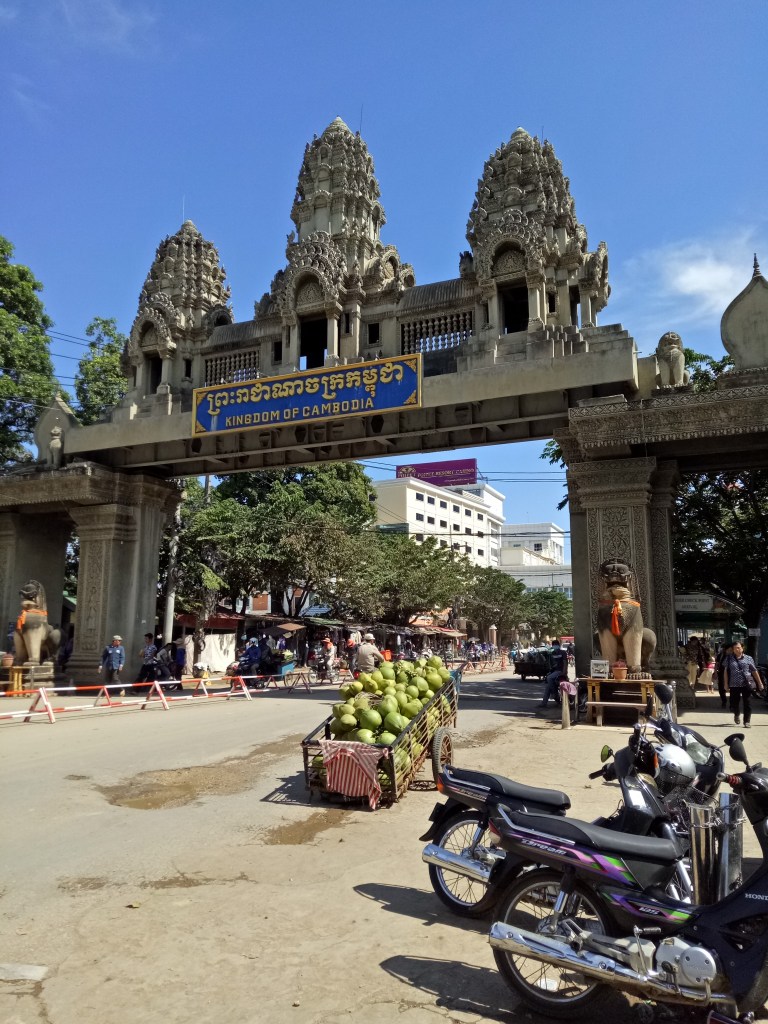
We hit the border in the heat of the middle of the day. We get dropped off by our friendly bus driver and have to walk over railway tracks and through the hustle and bustle of shops, markets, and inadequate signage to try and find where we are supposed to go. The place is full of people directing you but there are also many touts so you don’t know who is for real. Finally after 100 metres, a proper sign. At least we wait in air-con while exiting Thailand border control. Then it’s a 150 metre walk ‘across’ the border along a flagged walkway beside a major road filled with people selling things, transport, noise, and chaos, and past smelly waterways, dirt, and rubbish, until we see an ornate stone archway erected nearby that denotes we are entering the Kingdom of Cambodia. Here, in a building to the side, we have to pay our USD$30 for the visa as well as 100 Thai Baht ‘local payment’, and wait while it is processed. It takes about 10 minutes. Then another long walk in the outdoor heat and sun to a small low building that is Cambodia border control. Here, the touts are numerous, all vying for you to choose them and their taxis/buses/tuktuks (pronounced took tooks) etc over public transport to Siem Reap. My Viet friend and her Finnish husband get sidetracked by a tout offering a taxi ride to Siem Reap for USD$30. Even though she is Asian and speaks Cambodian, thirty dollars is his best price. I decide to join them and we can split it three ways. Minutes later we are in a comfortable air-con taxi speeding away for the three hour trip.




Apparently, the Cambodian money, the Real, has little value here and US dollars speak volumes instead. I changed some money before entering Cambodia so I am well prepared, but I have also loaded my cash passport debit card with them too and find out that I can withdraw USD from ATMs. As I have a different destination in Siem Reap to my friends, the driver calls up a ‘friend’ who will take me in a tuktuk to my hostel. I have come across this ‘I have a friend who will help us’ thing before and it usually means you have to pay. Once we get to Siem Reap and meet the tuktuk driver, I confirm that I will not have to pay anymore. “No, no”, he assures me, “I want you to trust me, so no payment”. My friend and her husband warn me that he will want something. I nod and get in anyway and we head through town looking for my hostel, mysteriously called En Hostel. It is exciting to see my first glimpse of Siem Reap, and I am transported back in time to the ‘old’ Asia that I remember growing up. The main roads are bitumen but the smaller ones are dirt. Even in town there are small village type homes. People sit in their little shops or roadside stalls selling snacks or petrol in plastic bottles (!) among a myriad of things; we pass a guy whose bicycle is loaded up with desktop fans to sell. It is all uniquely Asian.


A tuktuk drive means there is no cushion between you and the outside world, so you experience it raw and unprocessed. I love the ride. Tuktuks are basically a motorbike attached to a small two-wheeled trailer by a frame over the bike’s back wheel. They are essential to the way of life, and have comfortable bench seats hiding storage, with many of them ‘done up’, with fancy woodwork and a decorative fringe around the top. It is warm but the breeze from the tuktuk’s open ‘air-con’ helps cool me down. It seems everyone owns a motorbike or bicycle. I rarely see people walking. Even well-dressed women in heels ride past without helmets to mess up their hair.
As we stop at lights I hear the well rehearsed story from my driver. ‘My family is poor… I cannot get regular work… I will give you a good price for a tour of the temples tomorrow…I need money for my children’s schooling… I can take you there now, so you will trust me’, etc etc. We arrive at my hostel and he is still talking, persuading. I try to check in. The hostel manager is a lovely and patient man who tries to ignore my hanger-on. My driver steps outside for a cigarette but not letting me – his moneybag – out of his sight. I take the chance to ask the hostel manager for advice. He tells me that he only uses tuktuk drivers that he employs because the others have no regulation and sometimes leave customers high and dry without any backup or recourse. I try to work out who is telling me the truth – the driver who may very well be poor, or playing me for a sucker, or the hostel manager who is ensuring that one of his drivers will get some work out of which he will make money. The hostel manager comes across as genuine. I decide to give the driver one opportunity, and then reconsider. I ask him to drive me to where a hot air balloon is.
My goal on this trip was to push my boundaries, one of which is heights, and once I found out they do balloon rides, I thought it would be cool to float over Angkor Wat. However, it turns out that this balloon is attached to a rope so it only goes up and down (which got me thinking, what is the point of that?) but I realised it’s because of restrictions over the temple complex. But, not two minutes after leaving the hostel, before we even reach the balloon, my driver pulls over to the side of the road and tells me he is giving me to his ‘friend’ who will take me. No discussion. No permission. I am gobsmacked and think, but what about the whole Trust argument and the ‘my family is poor’ spiel? I have no choice. I have just arrived, have no real idea of where my hostel is, the sun is setting , and, like a schmuck, I trusted the guy to at least take me there. I change into the new tuktuk.
My new driver and I take off, but get to the balloon too late – it is shut. So, I ask him to take me to the entrance of Angkor Wat on the way back. I know that I cannot get in as I have no ticket yet, but I just want to see it. When we arrive, we drive through hoards of people exiting, including monks in their eye-catching saffron orange robes, although I can see the outside and moat from across the enormous walkway/bridge. But it is also shut. I am disappointed but I’m not worried. I still have three full days here. I ask him to take me back to the hostel. When we get there I pay him the agreed price of USD$5 (despite everything being shut he still drove me and didn’t dump me like the other guy) and thank him. He asks me what time I need picking up tomorrow for touring the temples. I tell him I won’t be doing that or needing his services any longer. His face falls and he starts to argue, and tells me I need to pay him more. I tell him nothing was open – it was a direct drive there and back, and there was no waiting around for me. I am resolute in my decision and my anger although I remain calm. Then he tries to wheedle. He tells me that he went as fast as he could, but I know for a fact that tuktuks filled with families of six members passed us; that’s how ‘fast’ we were going. I say thank you once more and walk inside the hostel where he cannot follow me. It leaves me feeling pissed off and a sour taste in my mouth for my first experience of Siem Reap, but also reinforces what the hostel manager had said and that he is genuine.


The hostel is an old style guesthouse surrounded by others in a quieter part of town away from the centre, beautifully decorated with cane chairs and wooden long seats and stair banister. My room is spacious with free bottled water. It includes a simple breakfast of baguette bread, bananas, and tea or coffee and in total costs me USD$15 per night. The hostel manager, Sath (pronounced Sart), turns out to be a gem, and makes my stay easy and comfortable. Plus he such a lovely guy. He runs the hostel and lives there with his wife and two children. His background is in volunteer work where he managed the Siem Reap branch of an NGO providing education, infrastructure, and other assistance to poor families and communities. His calming manner makes my anger subside. He proves helpful when I question him about the temples and how to get there.
First, I am given a proper paper map which I love. Google maps doesn’t give me the crazy ads on the side or the disproportionate distances and weird logos of businesses, plus the fact that you can never fold it back to its original shape. I have heard these types of maps referred to as ‘old school’ by people younger than me, which I think is both hilarious and cool. I notice some roads have French names then I remember that France was a coloniser here though it is only the much older generation that speak French now, and even then only a few. Then Sath explains that you can access the complexes doing essentially two ‘tours’ – the ‘small’ or short tour and the ‘big’or long tour, which means temples that are closer and those further away. I organise to use one of his drivers and tuktuks for the next day – a viewing of sunrise over Angkor Wat – but it means I have to be ready and downstairs by 0430! I do a slight bow and palms clasped together, saying thank you (sounds like Aw Koong). He repeats the gesture and smiles.
There are signs everywhere denoting the appropriate behaviour and dress code for visiting the temples (be respectful, no smoking, no loud noises or talking, covering up with long sleeved shirts and trousers, do not take any stone from the temples as souvenirs – common sense really, so it is concerning that they need to have this kind of reminder) and speaking to monks. I am told that Cambodians are 80% Buddhist, 10% Christian, and 10% Muslim. The monks are highly respected here. They are happy to have photos taken but ask permission first; and a woman cannot touch them.
I wake early and am excited to start my trip. At 0435 I am in a tuktuk heading towards the ticket building which opens at 0500. I spy other Westerners in tuktuks doing the same. We line up inside the building in the appropriate row. I decide to buy a three day pass (USD$40) which allows me unlimited access to the complexes for three days within one week. The single day pass would not be enough time to see all that I want to see. I am second in line. While waiting for the ticket booth to open, I spy a group of young women nearby. They are wearing typical heat-reducing revealing clothes. I figure they either have missed the memo about what to wear or they don’t care. It will be interesting to see how policed it is and whether they will be let in with so much skin showing (later I see them again and they have all had to buy sarongs or scarves to cover up, which is heartening). The quiet murmur of tourists inside the building increases to a hubbub as the booths open and we are processed – my photo is taken, money changes hands, and I am issued with my ID pass that I need to show at every temple. Then I quickly exit and try to find my driver amid the 50 or so tuktuks and buses that are now outside the entrance. He finds me, manoeuvres expertly past the buses and we are on the road in the chill of the pre-dawn dark, racing to the main entrance. Along the way we pass other tuktuks filled with foreigners heading the same way. I am happy my driver is careful but fast. I feel like I am a contestant in the Amazing Race.


Next, we need to stop at the admission office where the tourist police are based and where my ticket is checked and punched with a hole. Everyone has to stop here at admission, including all tuktuk and bus drivers, even tourists riding bikes in (I decide not to hire a bicycle – even though it’s not too far from town, it’s too hot – this is the tropics after all – and later I see lots of tourists labouring in the heat on their bikes). It is good that it is a separate area from the ticket office. Once through, the race is on again.
We arrive to the road near Angkor Wat and park. My driver will wait here for me. I approach the entrance I saw briefly yesterday with a growing excitement. An enormous stone bridge crosses the complex’s moat and, after my ticket is checked, I walk among the crowd headed inside. It is still dark but there is a glimmer in the east and a lightening sky. I cannot see where I am going but many have brought torches along. I follow, watching my footing on the uneven surface. Once through the first doorway, I walk along the paved path towards a small lake that fronts the main temple complex. Here I can hear hundreds of people gathered for this event, as well as people selling food, drink, and souvenirs. I cannot believe how many people are here, with more arriving. I try to find a decent viewing spot. We wait.
Not much later, the sky turns a lighter shade and the small lake reflects the sky’s colours as well as the silhouetted outline of the three pagoda shapes that form the central temple. It is beautiful. Everyone talks at a hushed volume in order to not break the distinct spiritual mood of witnessing the dawn over this special and revered place.


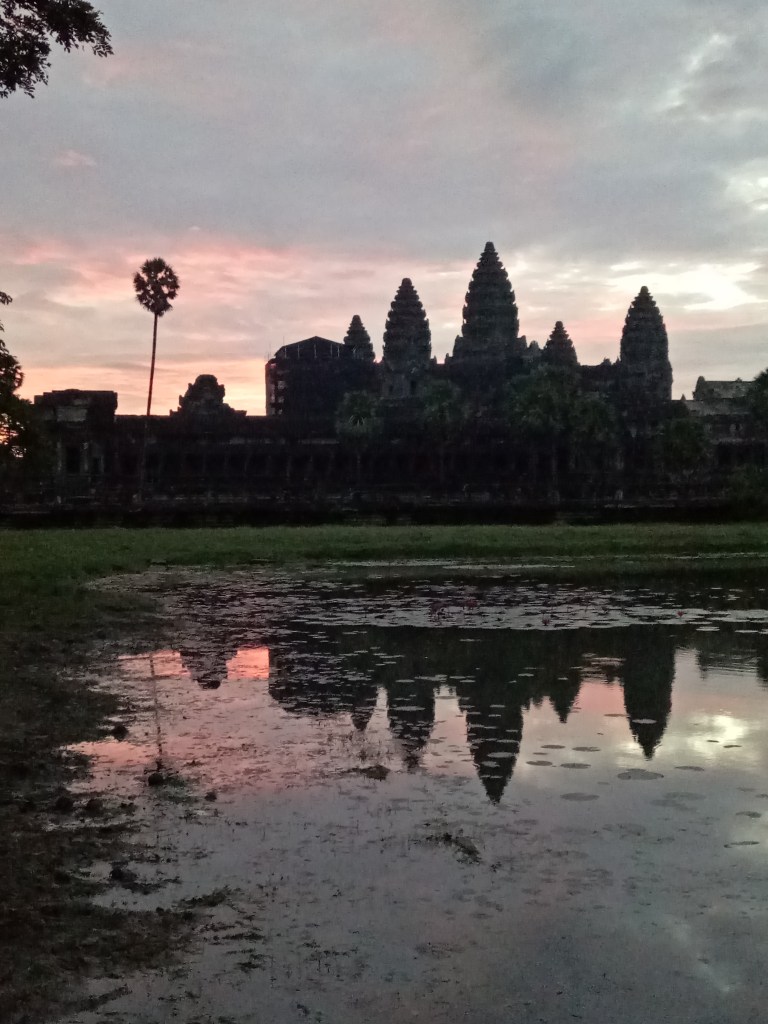


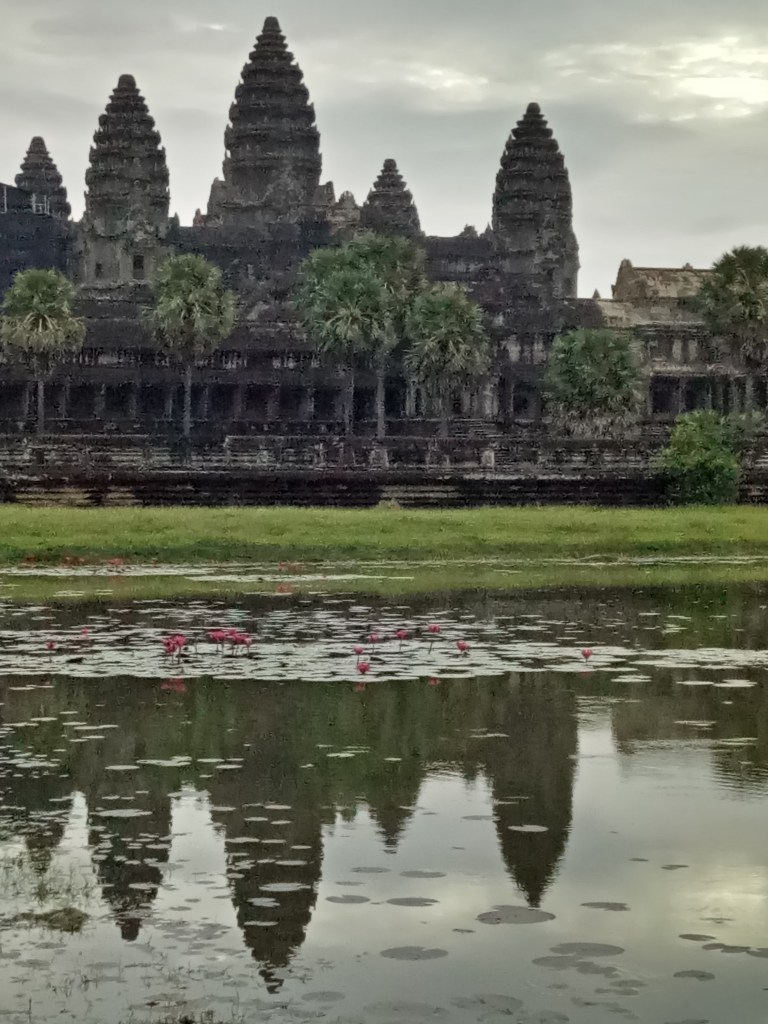
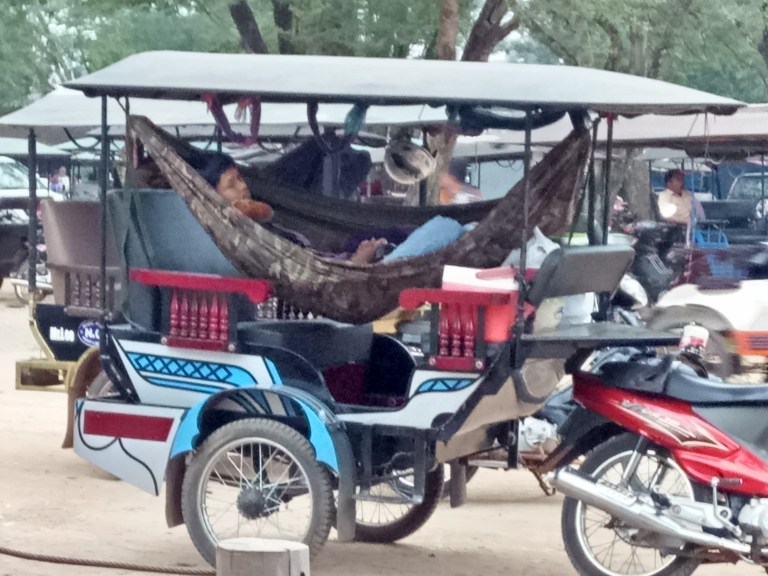
I am returning my hostel for breakfast briefly and will come back here a bit later. About half of the crowd head inside the temple proper. I join the file of people heading out through the doorway, as many just came for the sunrise, passing carved stone snake heads that were symbolic guards of the temple, whose long bodies form the balustrade of the path. My driver is waiting. Others have already set themselves up on a hammock in their tuktuks for a nap while waiting for their customers. We head back to the hostel through town. I need a decent start to the day as it will be a long, hot one. I have already bought fruit and snacks to cover my lunch, as I don’t want to interrupt my viewing time and flow by stopping for lunch.


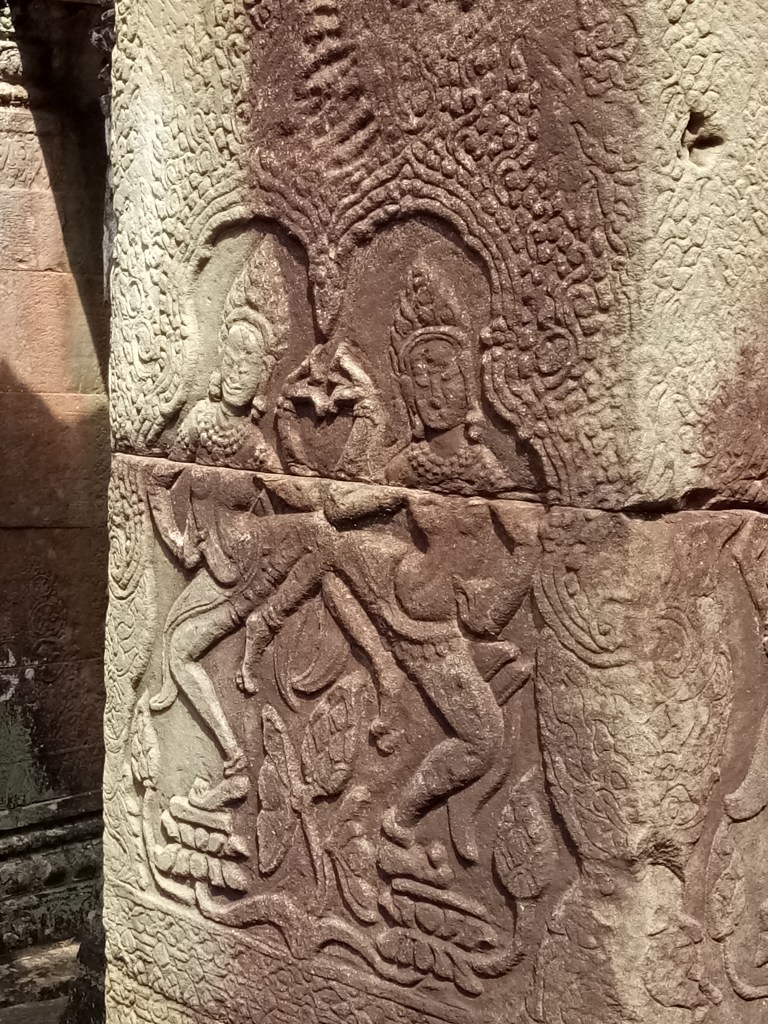
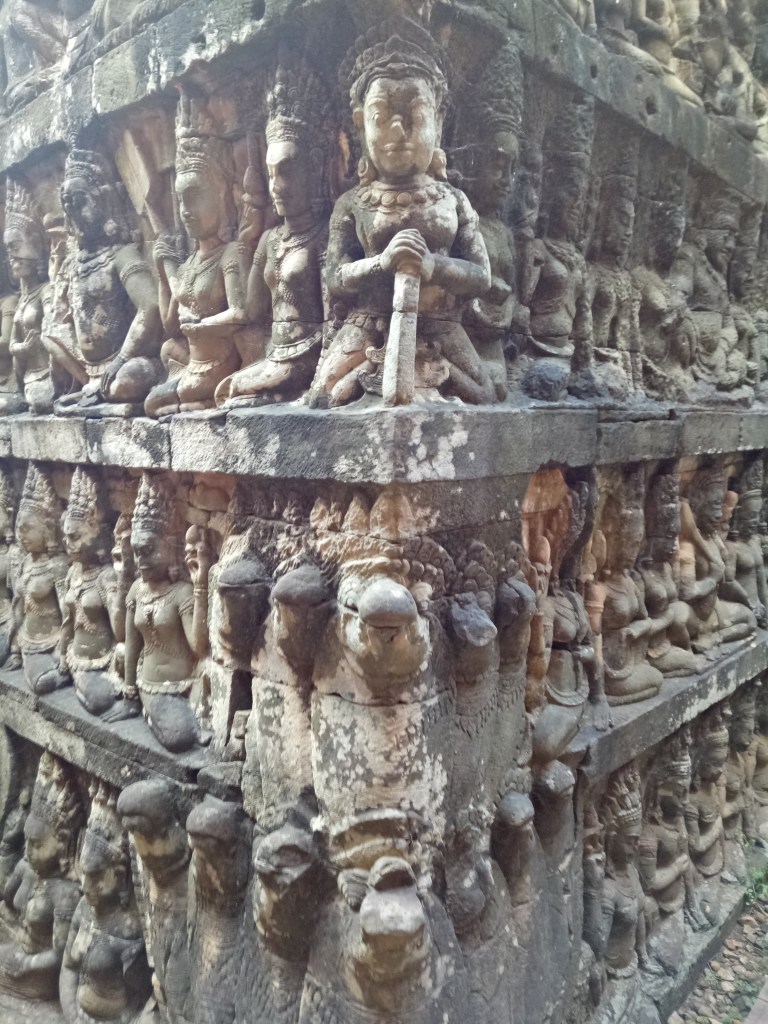
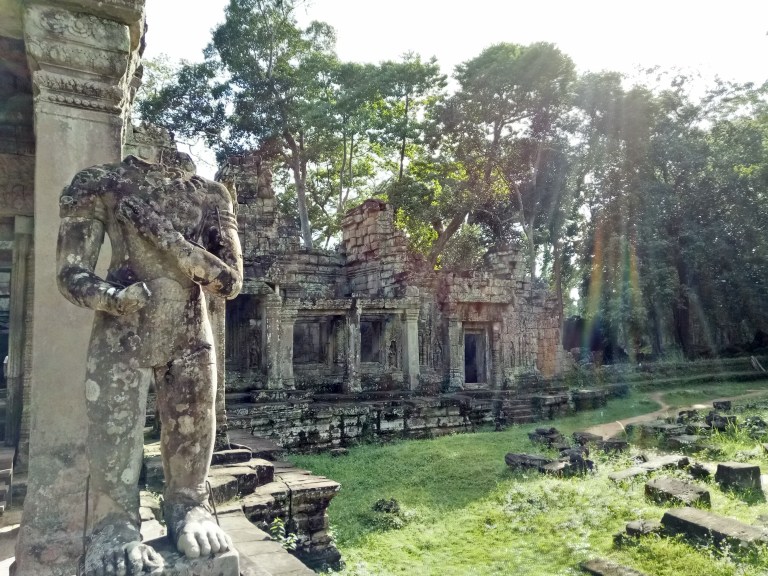
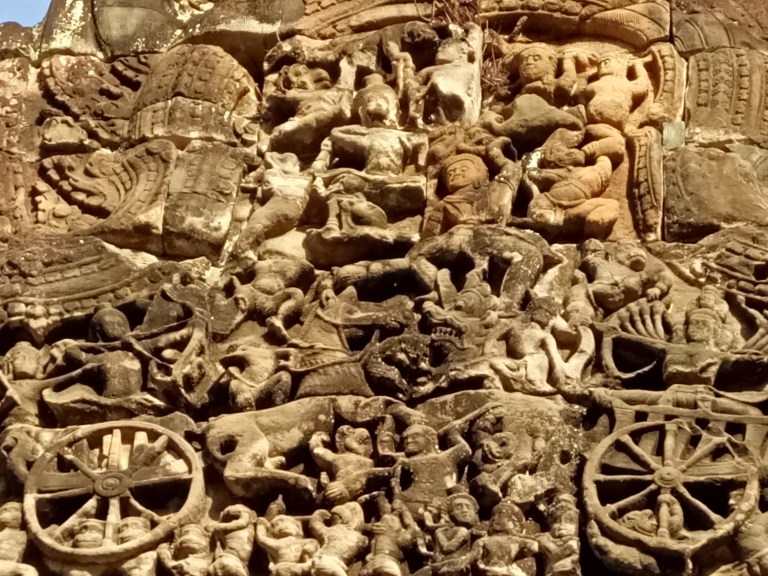
The grouping of temples here is known collectively as Angkor Wat although it is made up of many temples and palaces, with different names and distinct purposes. The main temple of the Angkor complex, called Angkor Wat and being the drawcard and the jewel in the crown even appearing on the nation’s flag, is the most popular and is surrounded by an enormous moat at least 100 metres wide at the entrance, which, on first look, I thought was a lake. There is much that is on a grand scale here. The Angkor Wat temple is set in gardens, surrounded by the moat, that are a couple of kilometres square. Lucky I have my walking shoes on. Originally it was built to honour the Hindu god by a ruler in the Khmer Empire, King Suryavarman II. The forces of Hinduism and Buddhism battled and eventually Buddhism won. It was repurposed as a Buddhist temple complex in the 12th century. The prime numbers of 1, 3, 5, and 7 are revered and appear in much of the architecture here. The bas-relief sandstone carvings of the walls and support pillars, pagodas, window frames, and doorways depicting gods and deities, people, battles, and ceremonies are precise and delicate; carvings that look like wood from a distance are actually carved stone! It has lasted well over the 900 years or so since construction. Some repair and restoration has taken place of course, and clearing of encroaching vegetation.
Even though we return by 0730 it is already hot and it only gets hotter. I re-enter Angkor Wat and make my way over the causeway to the inner section through a series of walkways, going up and down over door jambs of paved stone. All is placed with rigorous accuracy and is architecturally meticulous. It is magnificent.
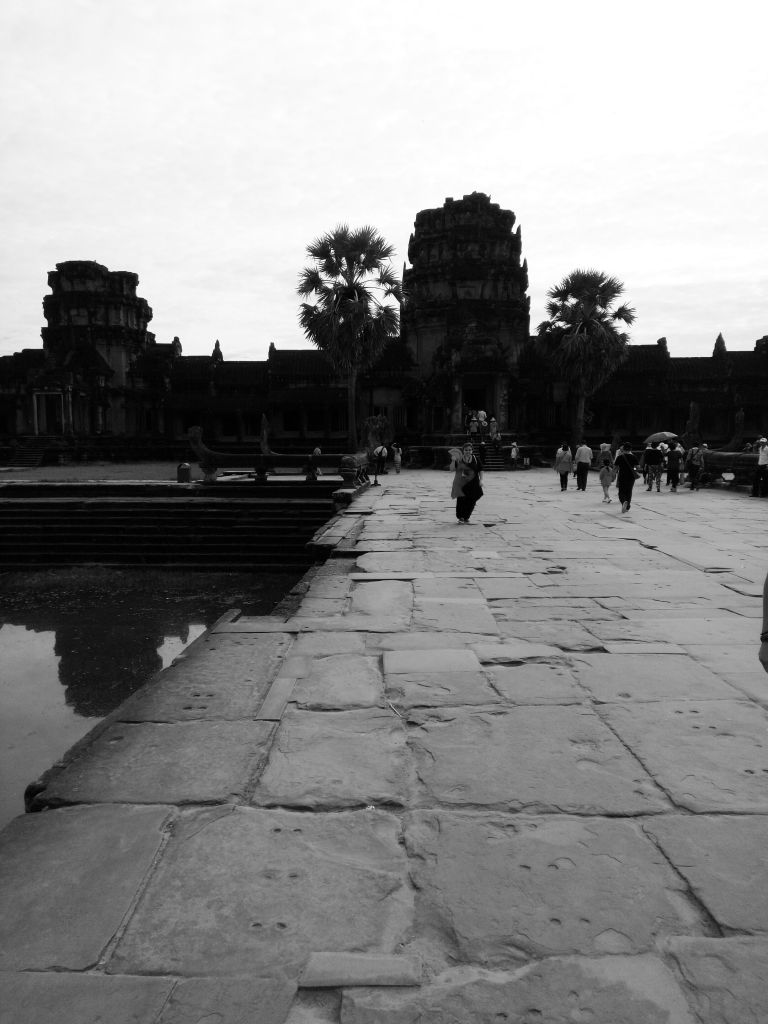


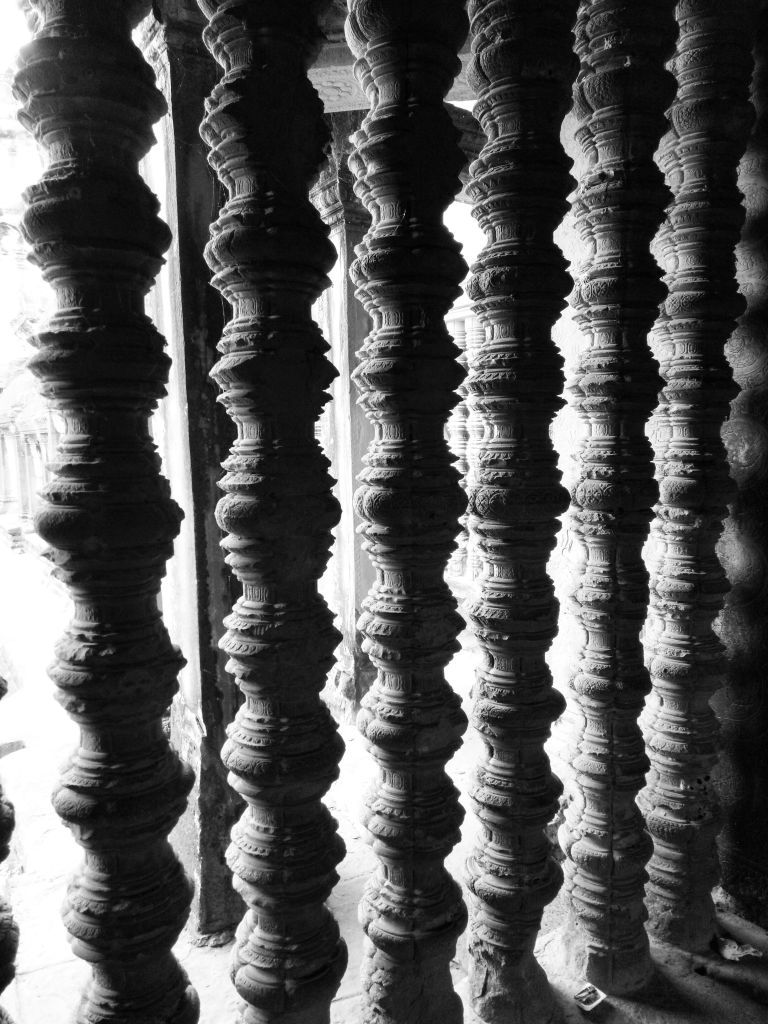


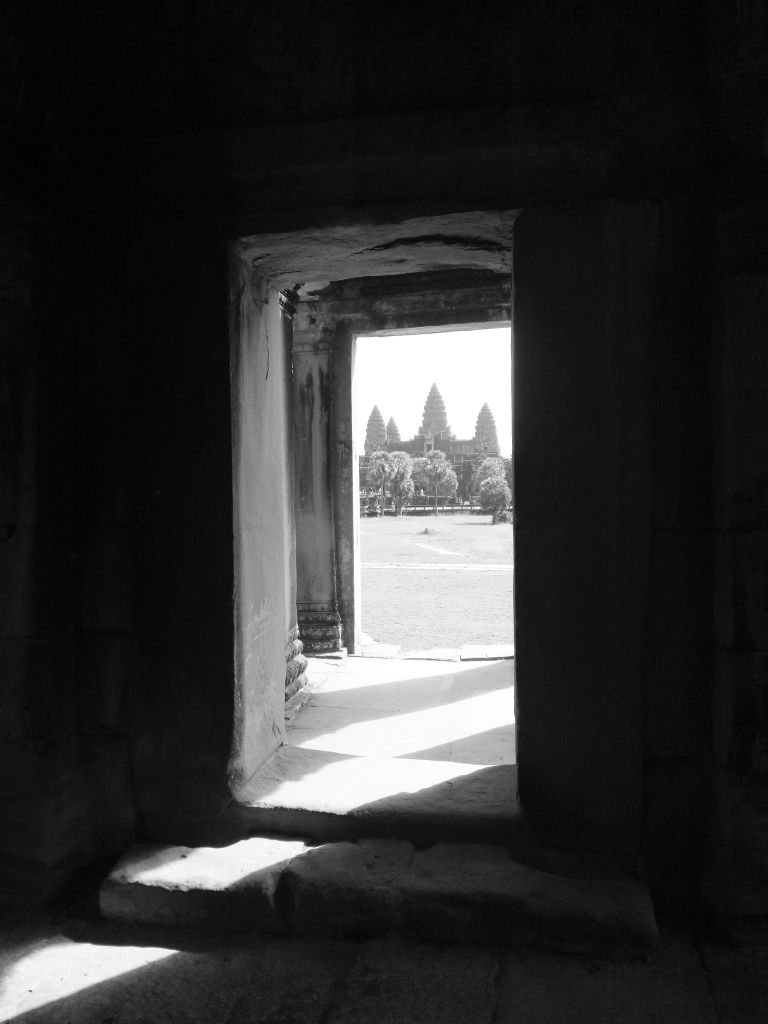
I spend about an hour and a half walking around in awe.
But there is so much more to see. I exit and look for my driver, Vishna, recalling that he had a blue long sleeved shirt on. This proves helpful, remembering what he wore, because there are numerous drivers all waiting at the exit. On to the next temple. I ask to be taken somewhere with trees as it is so hot. Vishna shakes his head. There is obviously a set route for the short tour, but I politely insist because it is so hot. He nods and smiles. The tuktuk ride keeps me cool throughout the day, drying off the sweat long enough to reapply my sunscreen. The heat is dehydrating so I end up drinking over 2 litres of water. When I get home to the hostel later that day I am sunburnt, and filthy.
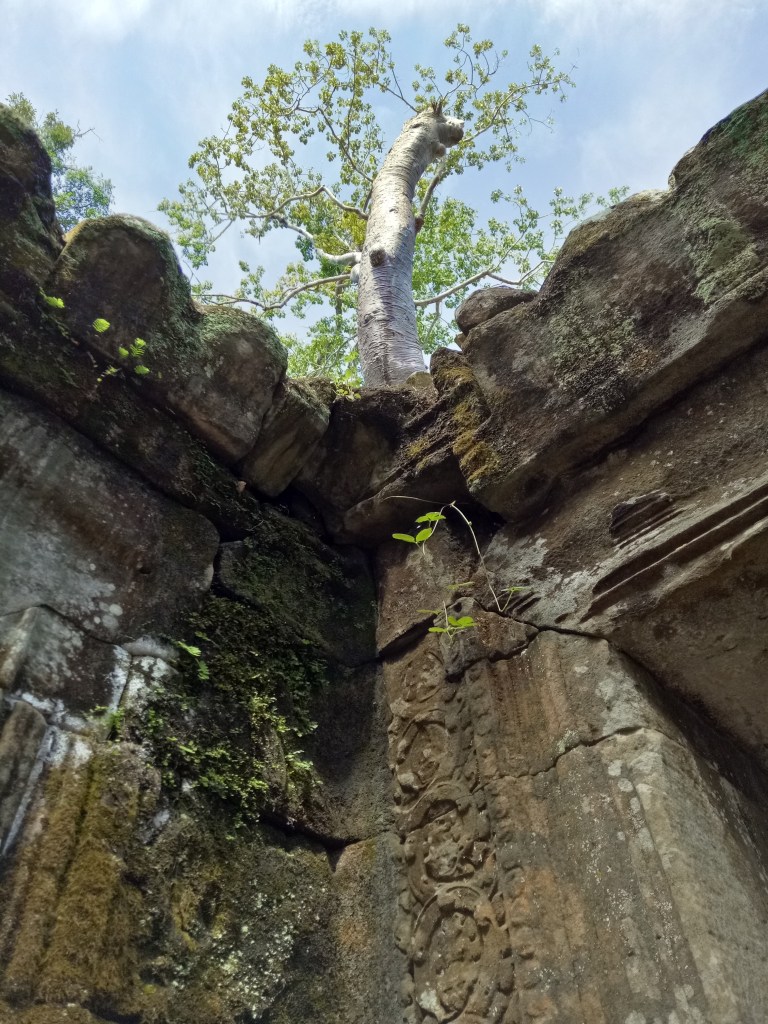
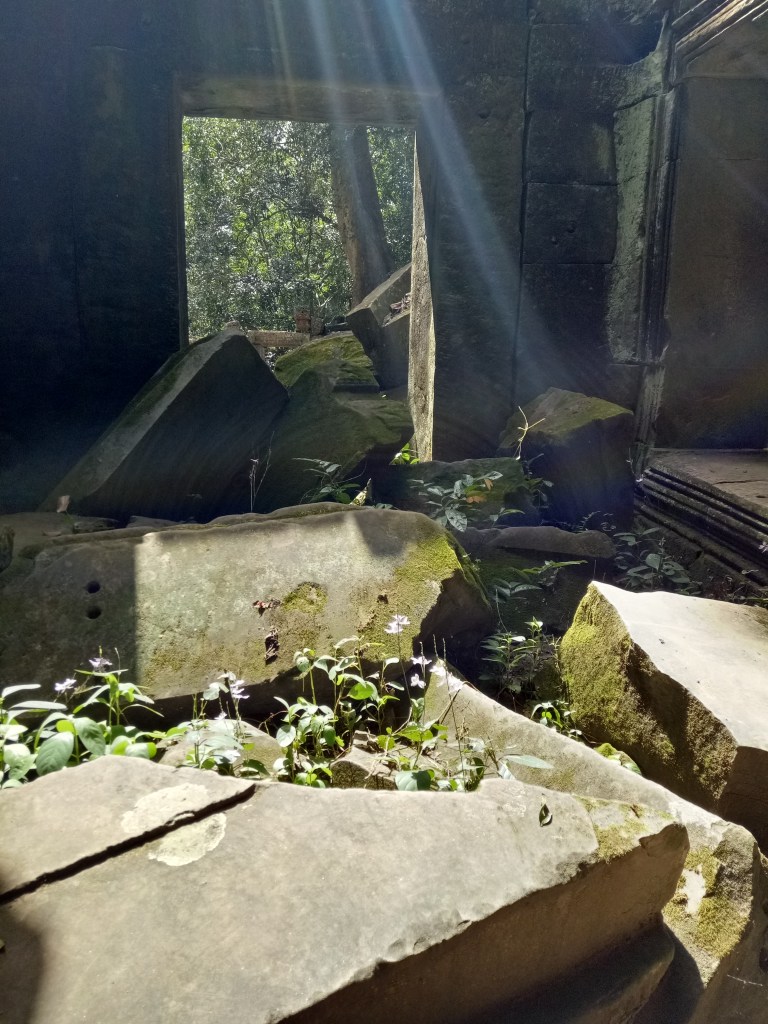
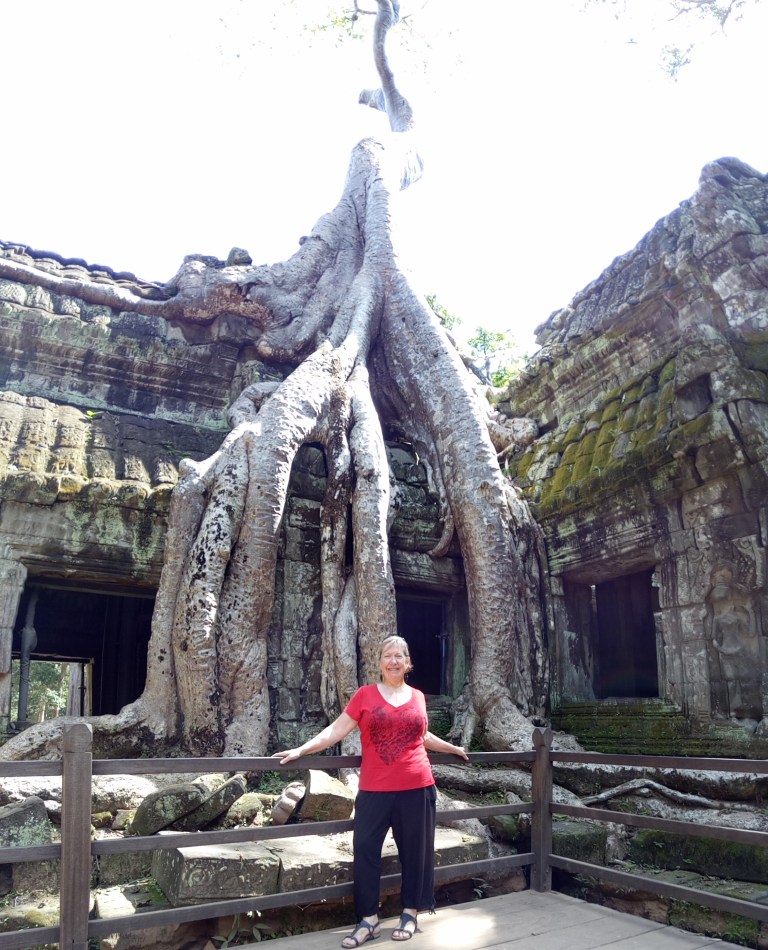
Ta Prohm, otherwise known as the Tomb Raider temple, is the one with giant fig trees that have interwoven their roots throughout the small complex in a picturesque dance. It is quite spectacular. Upon entering, the silence is almost eerie, and the atmosphere is one of calm in keeping with its use as a monastery and university. You can imagine people walking pensively through the cloisters here in contemplation or study. I love the colours of the worn sandstone and moss. Walking around, I find myself alone, and am drawn to some flowers that are growing among the ruins amid shafts of filtered sunlight. I feel like I am in Tomb Raider for a split second. It is an unusual moment.




Sras Srang was an ancient reservoir but it looks like a swimming pool built for a King. It is at least 300-400 metres wide and looks almost a kilometre long. It sits opposite another Buddhist temple, Banteay Kdei, originally built as a residence for the King’s household. Every one of these complexes have large stone gateways through which you enter, with a ticket inspector parked outside. They are easily accessible by road, and nearby there are the usual tourist stalls selling sarongs, cold drinks, scarves, and other souvenirs. As soon as you near these stone gates you are inundated with a high pitched “Hallo, madame, you want buy … (insert cold drink/pants/scarf/T-shirt/local guidebook/painting/woodcarving etc) only 2 dollar” – that is US dollars. Each temple also has signage denoting the efforts of various groups like UNESCO who have supported the restoration either via financial means or with people willing to uncover and re-erect the fallen down buildings and walls.




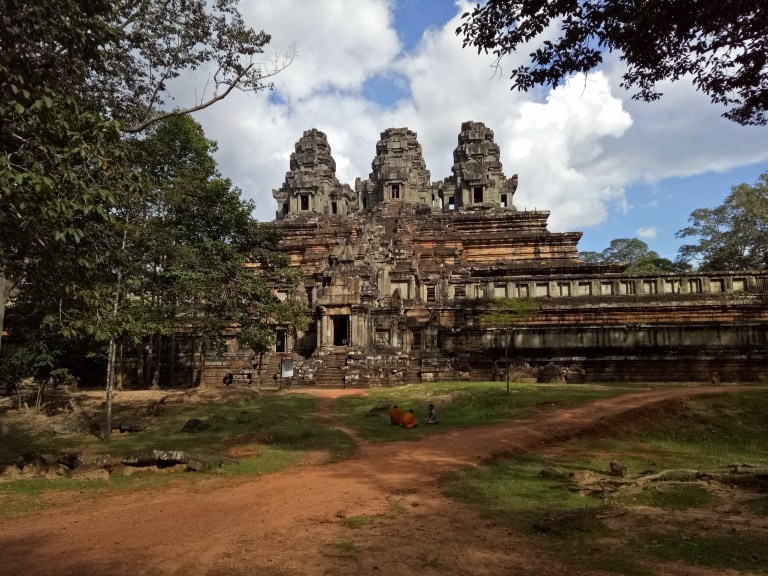
Next is what looks like a pyramid, Ta Keo. It was built as a state temple and originally had a moat. It has very steep sided steps on the pyramid. I start going up but stop. They are so steep that I am not prepared to climb further. I could probably get up to the top without issue. It’s the getting down that concerns me, without slipping and breaking something. So I wander inside the walls instead.


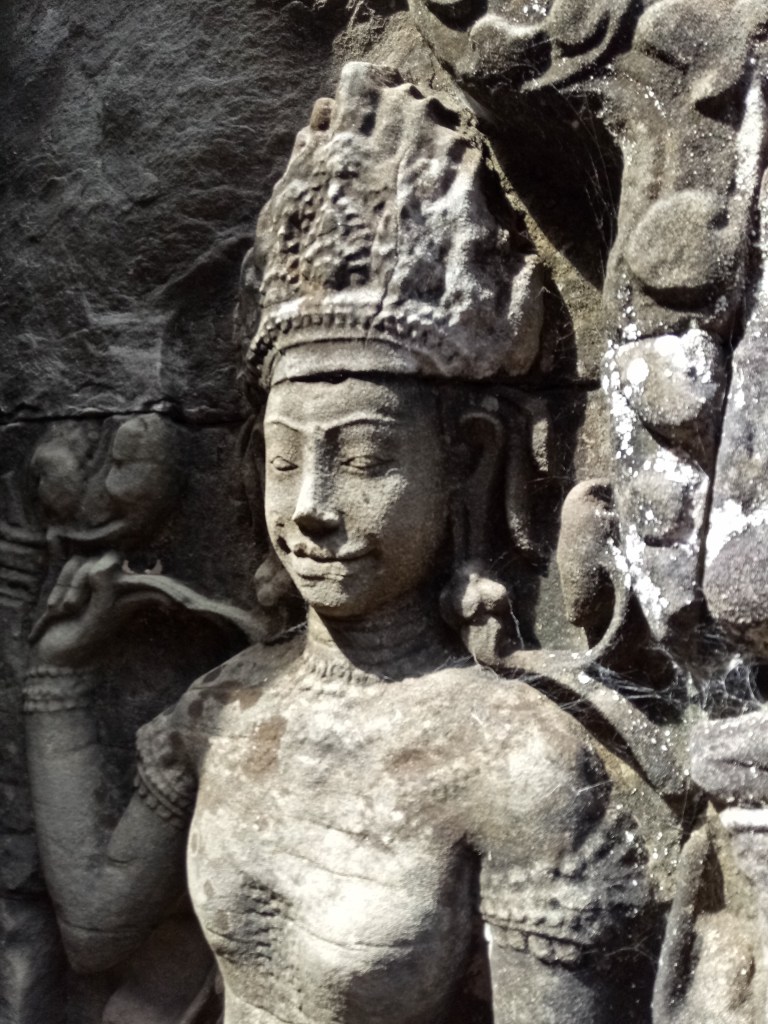
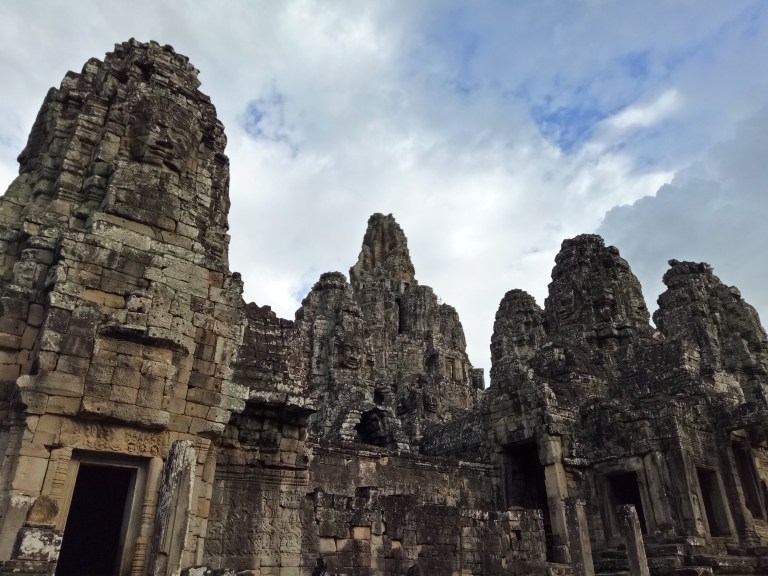
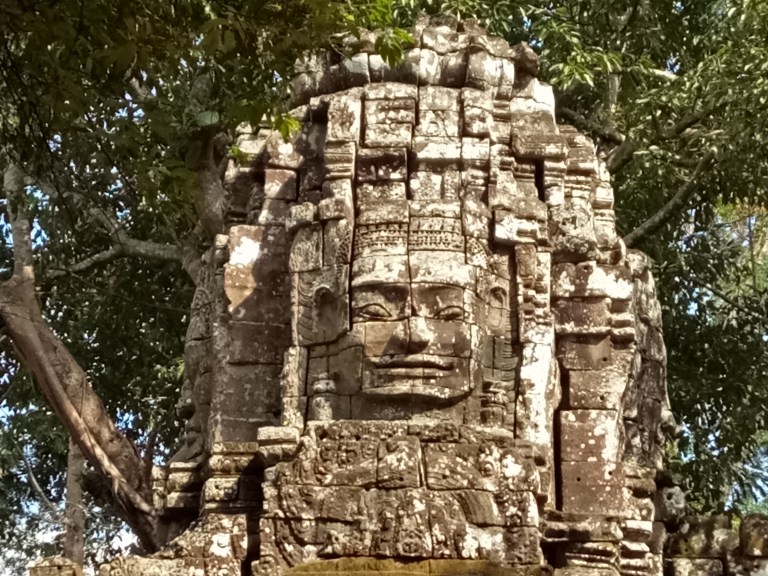
We enter a new complex bordered by impressive stone arched gateways and causeways fronted by the snake heads again which protect the temple and the ruler, but this time the causeway is lined with burly bodyguards holding the serpent’s body in check. This complex is called Angkor Thom and was a capital at one point. The star in this crown is the temple complex of Bayon whose serene faces carved in sandstone look down upon those who enter to worship. It has a beautiful feeling about it.




The short tour is over and I am exhausted. I ask my driver, Vishna, if we can go back via Angkor Wat again to see the sunset. I re-enter the complex but five minutes later there is an afternoon storm and I am caught along with many others inside the ancient stone carved walls that prevent us from getting wet while waiting for the rain to stop. It is a remarkable feeling to stand out of the rain and witness the storm, protected by an edifice that has been standing for so long and probably will for many years to come.


Cambodia seems to attract hippies. I see a few, young and old, who shun the outside world and love the simple and cheap lifestyle. I meet two men in particular, both French, who left France for Cambodia and never went back.
The next day I give myself a day off, buy some souvenirs, and taste more food. It is spicy but with a strong sweet and sour taste, similar to Thai food but uniquely Cambodian. I find it delicious. The beer is like normal beer – refreshing with spicy food – but what I find funny is that when I ask for an Anchor beer from the menu, the waitress checks whether I mean Anchor or Angkor; they pronounce Anchor beer as Anchaw to differentiate.
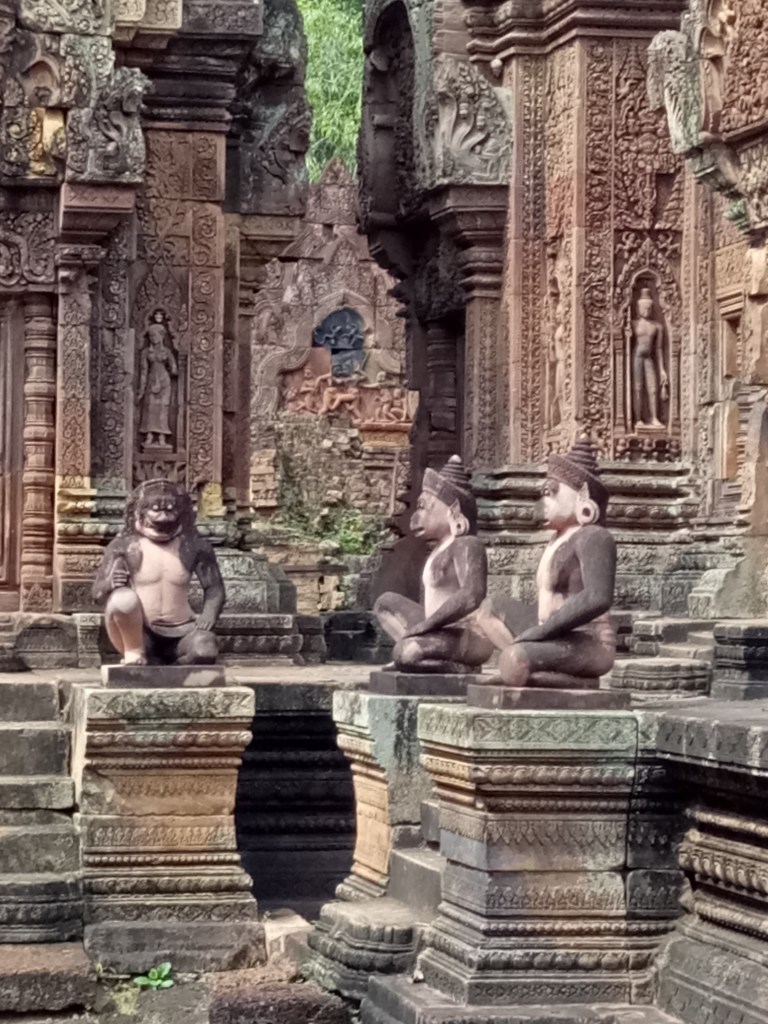
The following day is my last. It is the long tour day. Despite these temples being further away, it is a shorter day. We start with Banteay Srei, otherwise known as the Women’s Temple. What is unusual about it is the use of pink sandstone. It is 37 km from town – a long and bumpy tuktuk ride – but the best part is that I get to see the simple villages (they remind me of Malay kampungs), water buffalo, and rice paddies in the countryside.


Banteay Srei appears to be popular with tourists as there are lots of buses there when we arrive. It is known as the women’s temple as Srei means woman in Khmer, but also possibly because it is a miniature version of the other grand palaces and temples. Its beauty is renowned due to the delicate and intricate carvings. Unfortunately, I enter the area the wrong way and one of the ticket guys takes me back to the proper entrance on the back of his motorbike. Sometimes it’s fun getting into trouble.


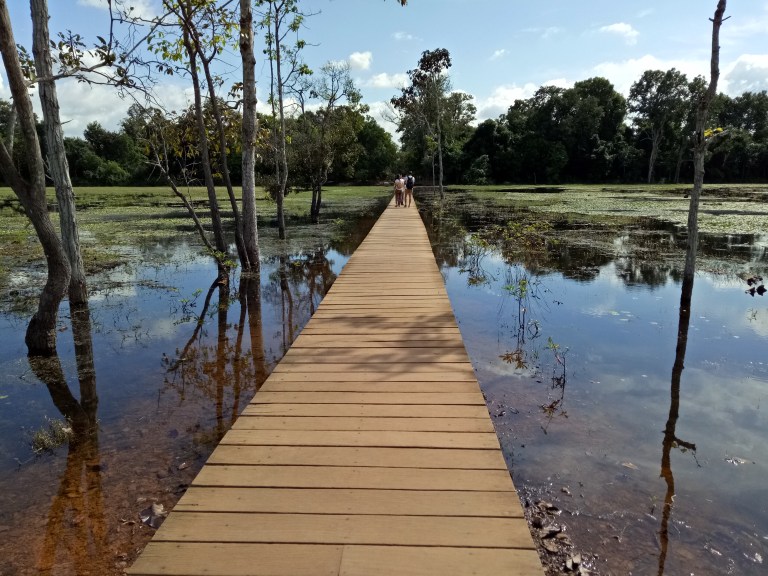
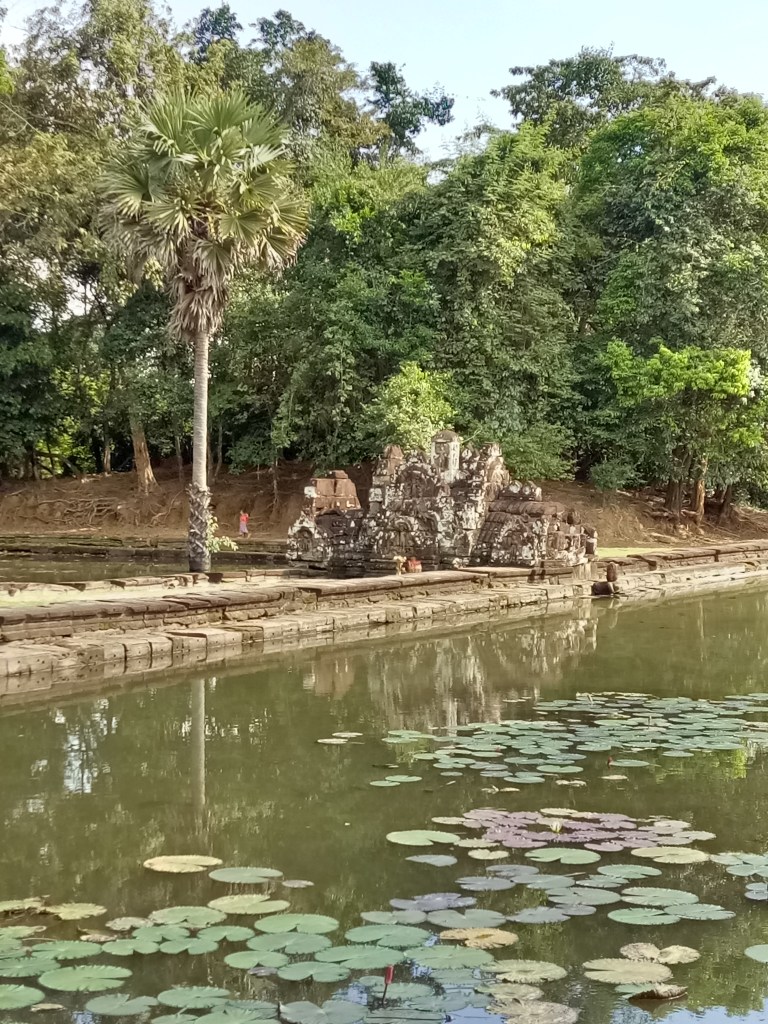
It often happened that other tourists were doing the same tour and we would see one another at the next temple. However, a certain group of three, with the woman dressed up and wearing high heels to see the ruins (just, why?) would see me and follow me to get their photos because they liked where I stood to get my shots. It became annoying after a while so I avoided them. Next is another steep-stepped pyramidal one which reminds me of the Aztec pyramids and was actually built around the same time, Pre Rup, that appears to have been made of bricks rather than cut stone. I don’t climb up it. East Mebon is cool as four stone elephants guard the four corners of the complex’s outer wall. Ta Som is another with serene faces and strangler figs. The next one we visit, Neak Prean, is unusual as it can only be accessed via a narrow wooden bridge across what looks like a large lake. Built as a kind of spa for bathing and health, it has a mini lake with a small inaccessible temple in the centre. I see a monk visiting and politely ask him for a photo. He says yes but a nearby female park ranger tells me no. Surely, the well respected monk’s wishes should be obeyed? The only reason she can give is that there would only be two of us (not a prime number therefore bad luck?) but it’s ok with 3 or 5 people. I ask her to join the monk and me, to make our number up to three, in probably the most awkward photo on record. Later on the way out, back across the wooden walkway out of the sight of the park ranger, the monk tells me I can take a photo with him.




The last temple is Preah Khan, another enormous complex which looks like it was originally a palace, due to the grand facades and entrances. In this palace, all the walkways are in perfect alignment with the following portals. What has surprised me is how similar in architecture all these buildings are, obviously due to the time they were built, but how each one, even though they became temples, had a completely different function. And how it is all on such a vast scale.




After another fabulous meal I say farewell to Sath and his family. In the morning I cram into another minivan between suitcases (I have to climb in the driver’s side door to get to my seat!) for the trip back across the border to Thailand. As we head out of town in the air-con bus, I realise that I have spent each day in Siem Reap in a tuktuk – close to the action – of which I am glad. We pass by the big hotels and huge tourist buses. I am so happy to have stayed in a cheap hostel, getting down and dirty in my tuktuk. I know many prefer their comfort. To me, backpacking (with a suitcase) is my kind of travel.


 Jen's Magic Carpet Ride